
About
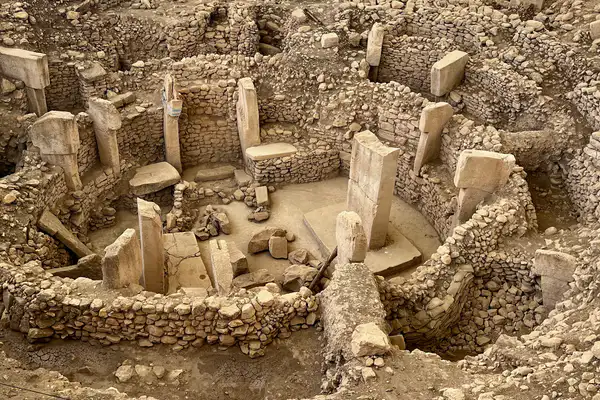
Göbekli Tepe is the oldest known temple complex in human history — a discovery so revolutionary that it has fundamentally rewritten our understanding of civilization itself. Located on a limestone ridge 15 kilometers northeast of Şanlıurfa in southeastern Turkey, this 11,600-year-old sanctuary was built by hunter-gatherers who had not yet invented agriculture, pottery, or the wheel. The discovery, made by German archaeologist Klaus Schmidt in 1994, overturned the long-held belief that religion emerged from settled agricultural societies. Instead, Göbekli Tepe suggests the opposite: that the need for communal worship may have driven humans to settle down and develop agriculture. The site consists of approximately 20 circular enclosures, of which only 4 have been fully excavated. Each enclosure contains massive T-shaped limestone pillars arranged in circles, with two taller central pillars (reaching up to 5.5 meters and weighing 10-20 tons) facing each other. These pillars are decorated with extraordinary relief carvings: lions, bulls, boars, foxes, snakes, scorpions, spiders, vultures, and abstract symbols. Some pillars have carved arms and hands, suggesting they represent humanoid beings — perhaps gods, ancestors, or spirits. What makes Göbekli Tepe truly astonishing is not just its age, but the implications of its construction. Building such a monument required hundreds of people working together over extended periods. These people were nomadic hunter-gatherers — they had no permanent settlements, no domesticated crops or animals, no pottery for storing food. Yet they organized themselves to quarry, transport, carve, and erect pillars weighing up to 50 tons. This suggests a level of social organization, spiritual motivation, and artistic achievement that was thought impossible for pre-agricultural societies. Even more mysterious is the site's deliberate burial. Around 8000 BC, the builders intentionally filled the enclosures with soil and debris, burying the entire complex. The reasons remain unknown — was it to preserve the sacred site? To end a ritual cycle? To protect it from enemies? The deliberate burial preserved Göbekli Tepe for 10,000 years until its rediscovery. Only about 5% of the site has been excavated, with 95% still buried — holding secrets we cannot yet imagine.
Historical Significance
“The oldest known monumental architecture in the world, predating agriculture and pottery”
القصص
3History
👑 Built by
Pre-Pottery Neolithic hunter-gatherers (unknown culture)
~9600 BC - Construction begins on earliest enclosures (Layer III)
~9000-8500 BC - Construction of the four main excavated enclosures (A, B, C, D)
~8000 BC - Site deliberately buried with soil and debris
~8000 BC onwards - Site forgotten by history
1963 - First survey by American and Turkish archaeologists (misidentified as medieval cemetery)
1994 - Klaus Schmidt (German Archaeological Institute) recognizes the site's true age
1995-2014 - Klaus Schmidt leads systematic excavations
2014 - Klaus Schmidt dies; excavations continue under Turkish-German team
2018 - UNESCO World Heritage Site inscription
2019 - Taş Tepeler Project begins exploring 12+ similar sites in the region
Present - Only ~5% excavated; 95% still buried