
About
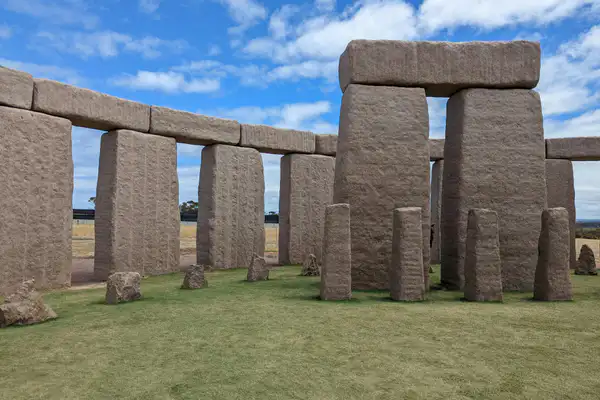
s greatest debates, with theories ranging from glacial transport to elaborate sledge-and-roller systems to waterborne rafting along the Bristol Channel. Shortly after or alongside the bluestones, the enormous sarsen stones arrived from the Marlborough Downs, roughly 25 miles to the north. These sarsens — a form of silicified sandstone harder than granite — weigh up to 25 tonnes each, with the largest, the Heel Stone, weighing approximately 35 tonnes. The sarsen circle consists of 30 uprights capped by a continuous ring of lintels, joined with sophisticated mortise-and-tenon and tongue-and-groove joints — woodworking techniques applied to stone, found nowhere else in prehistoric Europe. Within this outer circle stands a horseshoe of five trilithons (pairs of uprights capped by a single lintel), the tallest reaching 7.3 meters above ground, with an estimated 2.4 meters buried below. Stonehenge's purpose has been debated for centuries — temple, astronomical observatory, healing sanctuary, coronation site, or necropolis for an elite dynasty — and the truth likely encompasses elements of all these interpretations. The main axis of the monument aligns precisely with the midsummer sunrise and midwinter sunset, demonstrating that its builders possessed sophisticated astronomical knowledge. The surrounding landscape is dense with complementary Neolithic and Bronze Age monuments: the Avenue, a ceremonial processional route; the Cursus, a mysterious 3-kilometer linear earthwork predating the stone circle; Durrington Walls, one of the largest henge enclosures in Britain; and Woodhenge, a timber counterpart that may have symbolized the world of the living, while Stonehenge represented the realm of the dead. More than 350 burial mounds dot the surrounding chalk downland, making the Stonehenge landscape one of the most significant funerary complexes in prehistoric Europe. Designated a UNESCO World Heritage Site in 1986, Stonehenge receives over 1.5 million visitors annually and remains an active site of pilgrimage, celebration, and wonder — a place where the deep human need to mark time, honor the dead, and connect with forces greater than ourselves is written indelibly in stone.
Historical Significance
“Stonehenge is the pre-eminent monument of European prehistory and arguably the most recognizable archaeological site on Earth. Its significance radiates outward from architecture, through astronomy, ritual, and social organization, to the very heart of what it means to be human. The monument represents the pinnacle of a tradition of megalithic construction that swept across Atlantic Europe during the Neolithic period, but Stonehenge surpasses all contemporaries in the precision of its engineering, the ambition of its stone transport, and the sophistication of its astronomical alignments. The sarsen circle's continuous lintel ring — curved to form a perfect circle, with each lintel shaped to account for perspective when viewed from ground level — demonstrates a level of architectural refinement that would not be matched in Britain for three thousand years. The monument's astronomical significance is profound. The main axis aligns with the summer solstice sunrise and winter solstice sunset to a precision that rules out coincidence. The Station Stones, set at the corners of a rectangle within the outer bank, mark lunar as well as solar extremes. Some researchers have argued that Stonehenge functioned as a Neolithic "computer" capable of predicting eclipses, though this remains debated. What is certain is that the builders understood and encoded celestial cycles with remarkable accuracy, embedding cosmological knowledge into the very fabric of the architecture. This was not mere observation — it was a cultural statement that the community could read, predict, and perhaps control the movements of the heavens. Socially and politically, Stonehenge speaks to the existence of a complex, hierarchically organized society capable of mobilizing vast labor forces across enormous distances. The transport of the bluestones from Wales — whether by human effort, glacial action, or a combination — implies networks of trade, alliance, and shared belief stretching hundreds of miles. Isotope analysis of human remains found at Stonehenge has revealed individuals who grew up in west Wales, suggesting that the monument may have served as a unifying pilgrimage site drawing people from across Britain. The cremated remains of up to 150 individuals buried at the site indicate it functioned as an elite cemetery for centuries. Stonehenge was not built by a single generation; it was a multigenerational project, a cathedral of the Neolithic, continually rebuilt and reimagined over fifteen centuries — a testament to a sustained cultural vision that transcends any single lifetime.”
القصص
2History
👑 Built by
Unknown Neolithic and Bronze Age peoples
c. 3000 BC - Construction of the circular ditch, bank, and Aubrey Holes begins (Phase 1)
c. 2900 BC - Cremation burials deposited in the Aubrey Holes; site functions as a cemetery
c. 2500 BC - Bluestones transported approximately 150 miles from the Preseli Hills, Wales, and erected in the Q and R Holes
c. 2500-2400 BC - Sarsen stones dragged from Marlborough Downs (25 miles); the outer circle and inner trilithon horseshoe are raised
c. 2280 BC - Bluestones rearranged into the oval and circle configurations visible today
c. 2000-1500 BC - Final modifications including the Y and Z Holes (never filled with stones) and the Avenue extension to the River Avon
c. 1100 BC - Active use and modification of the site appears to cease during the late Bronze Age
55 BC - Julius Caesar invades Britain; Roman writers later mention stone circles but do not specifically describe Stonehenge
c. 1130 AD - Henry of Huntingdon produces the first known written description of Stonehenge in his "Historia Anglorum"
1136 AD - Geoffrey of Monmouth's "Historia Regum Britanniae" attributes Stonehenge to Merlin the wizard
1620 - The Duke of Buckingham commissions the first known archaeological excavation at the center of the monument
1666 - John Aubrey identifies the Aubrey Holes and proposes a Druid connection
1720s - William Stukeley conducts systematic surveys, identifies the solstice alignment, and popularizes the Druid association
1798-1810 - William Cunnington and Richard Colt Hoare excavate over 400 barrows in the surrounding landscape
1900 - Stone 22 and its lintel fall during a storm on New Year's Eve, prompting the first restoration efforts
1901 - William Gowland conducts careful excavation during the re-erection of leaning Stone 56, finding flint and sarsen hammerstones
1915 - Cecil Chubb purchases Stonehenge at auction for £6,600 and donates it to the nation in 1918
1919-1926 - Colonel William Hawley excavates roughly half the site for the Society of Antiquaries
1950-1964 - Richard Atkinson, Stuart Piggott, and J.F.S. Stone carry out major excavations; Atkinson identifies the trilithon construction sequence
1986 - Stonehenge and Avebury inscribed together as a UNESCO World Heritage Site
2002 - The Stonehenge Riverside Project, led by Mike Parker Pearson, begins new excavations linking Stonehenge to Durrington Walls
2008 - Carbon dating of cremation burials pushes the site's use as a cemetery back to 3000 BC
2013 - The old A344 road bisecting the landscape is permanently closed, reuniting the monument with its Avenue
2021 - A controversial road tunnel scheme (A303) is approved, later subject to legal challenges, to remove traffic from the World Heritage landscape