
About
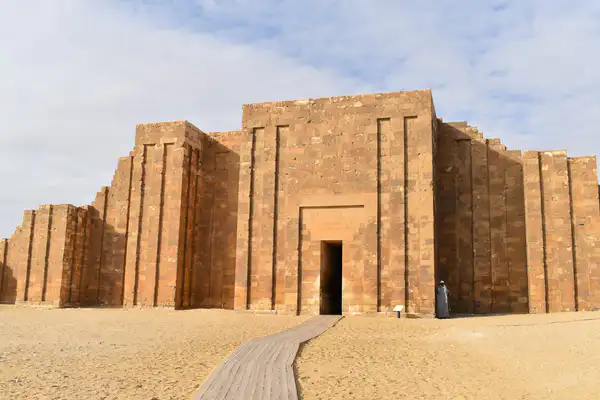
Saqqara is the vast ancient necropolis serving the Egyptian capital of Memphis, stretching over six kilometers along the edge of the Western Desert plateau overlooking the Nile Valley. It is one of the most significant archaeological sites in all of Egypt, containing monuments spanning the entire history of ancient Egyptian civilization — from the First Dynasty tombs of around 3100 BC to Coptic monasteries of the 6th century AD. At its heart stands the Step Pyramid of Djoser, the world's first monumental stone structure, a revolutionary architectural achievement that changed the course of human building forever. The Step Pyramid was designed by Imhotep, history's first named architect, for the Third Dynasty pharaoh Djoser around 2670 BC. Rising to a height of 62 meters in six diminishing tiers, it was the first structure in history to be built entirely of cut stone. Before Imhotep's breakthrough, royal tombs were flat-topped mudbrick structures called mastabas. Imhotep's genius was to stack six mastabas of decreasing size on top of one another, creating a stairway to heaven that allowed the pharaoh's soul to ascend to the stars. The pyramid sits at the center of a vast funerary complex enclosed by a recessed limestone wall over 10 meters high and 1.6 kilometers in perimeter. Beyond the Step Pyramid, Saqqara contains an extraordinary concentration of archaeological treasures. The Serapeum, an underground labyrinth of tunnels and chambers housing the enormous granite sarcophagi of the sacred Apis bulls, is one of the most mysterious monuments in Egypt. The Pyramid of Unas contains the earliest known Pyramid Texts — magical spells that are the oldest religious writings in the world. Dozens of beautifully decorated mastaba tombs belonging to nobles and officials feature some of the finest relief carvings in Egyptian art, depicting daily life in exquisite detail. In recent years, Saqqara has become the epicenter of Egyptian archaeology, yielding an astonishing series of new discoveries. Since 2018, excavations have uncovered hundreds of intact sarcophagi, perfectly preserved mummies, bronze statues, and complete funerary workshops, making headlines around the world and demonstrating that even after 170 years of systematic excavation, Saqqara still holds vast secrets beneath its sands. The site is part of the UNESCO World Heritage Site of Memphis and its Necropolis, inscribed in 1979, which encompasses the pyramid fields from Giza to Dahshur.
Historical Significance
“Saqqara's significance to human civilization cannot be overstated. The Step Pyramid of Djoser represents the birth of monumental stone architecture — the moment when humanity first demonstrated the ability to shape the natural world on a truly colossal scale. Before Imhotep conceived his revolutionary design around 2670 BC, no one had ever attempted to build an entire structure from carved stone blocks. His achievement laid the foundation for the Great Pyramids at Giza, which would follow within a century, and ultimately for all the stone architecture that defines civilization. The necropolis served as the primary burial ground for the capital city of Memphis for over three thousand years, and its tombs reflect the entire arc of ancient Egyptian history. The earliest tombs, dating to the First Dynasty (c. 3100 BC), belong to the very first rulers of a unified Egypt. The Old Kingdom mastabas contain some of the most vivid and detailed depictions of daily life ever created in the ancient world — scenes of farming, fishing, hunting, feasting, and craftwork that provide an irreplaceable window into Egyptian society over four thousand years ago. The Serapeum, discovered by Auguste Mariette in 1851, is unique in all of Egyptian archaeology. This vast underground complex of tunnels and chambers held the burials of the sacred Apis bulls — living incarnations of the god Ptah — in enormous granite and basalt sarcophagi weighing up to 70 tons each. The precision with which these immense boxes were carved and finished remains a subject of intense scholarly debate. Saqqara's importance continues to grow with each passing year. The wave of discoveries since 2018, led by Egyptian archaeologist Zahi Hawass and others, has transformed our understanding of the site and of ancient Egyptian funerary practices. The recovery of hundreds of intact coffins, the discovery of a complete mummification workshop, and the unearthing of the largest cache of bronze statues ever found in Egypt have demonstrated that Saqqara is far from exhausted as an archaeological resource.”
القصص
1History
👑 Built by
Imhotep (architect) for Pharaoh Djoser
c. 3100 BC - First Dynasty nobles begin building tombs at Saqqara
c. 2670 BC - Imhotep designs the Step Pyramid for Pharaoh Djoser
c. 2350 BC - Pyramid of Unas constructed with the first Pyramid Texts
664-332 BC - Late Period: Serapeum expanded, massive animal catacombs created
1851 - Auguste Mariette discovers the Serapeum following Strabo's ancient description
1924 - Cecil Firth begins systematic excavation of the Step Pyramid complex
1979 - Inscribed as part of UNESCO World Heritage Site (Memphis and its Necropolis)
2006-2020 - Extensive restoration of the Step Pyramid under Jean-Philippe Lauer's legacy
2018-present - Series of major new discoveries: intact sarcophagi, mummies, bronze statues, funerary workshops