
About
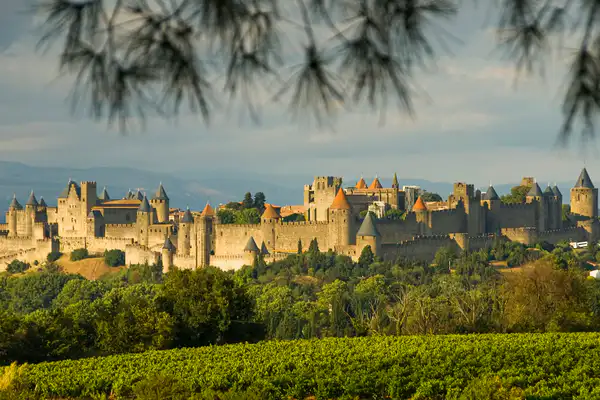
Carcassonne is the largest and most complete medieval fortified city in Europe — a double-walled citadel of 52 towers stretching over 3 kilometers, rising from the sun-baked plains of the Languedoc like a vision from a fairy tale. The Cité, perched on a hill above the River Aude, has been continuously fortified for over 2,000 years, from Roman Gaul through the Visigothic Kingdom, the Carolingian Empire, and the height of the medieval period. The city's double ring of curtain walls — the inner Gallo-Roman walls dating to the 3rd-4th century and the outer walls built by Louis IX and Philip III in the 13th century — enclose a living medieval town complete with a castle (Château Comtal), a basilica (Basilique Saint-Nazaire), cobbled streets, and houses that have been continuously inhabited for centuries. The fortifications represent the absolute pinnacle of medieval military architecture, with every conceivable defensive feature: murder holes, barbicans, portcullises, arrow slits, and towers positioned for crossfire. But Carcassonne's true power lies not in its stones but in its stories. This is the land of the Cathars — the heretical Christian sect whose extermination in the 13th-century Albigensian Crusade remains one of the darkest chapters in European history. Carcassonne was a center of Cathar protection, and its betrayal and fall to the Crusaders in 1209 set in motion decades of religious genocide. The legend of Dame Carcas, who saved the city from Charlemagne through cunning, gives the fortress its very name.
Historical Significance
“Carcassonne's significance is threefold: military, religious, and cultural. Militarily, it represents the most complete surviving example of medieval military architecture in Europe. The double curtain wall system, with the "lices" (open killing ground) between inner and outer walls, became the template for castle design across the continent. Religiously, Carcassonne is inextricably linked to the Cathar tragedy. The Cathars (from the Greek "katharoi" meaning "pure ones") were a dualist Christian sect that rejected the material world, the Catholic hierarchy, and the sacraments. They flourished in the Languedoc, protected by local lords like the Trencavel viscounts. Pope Innocent III launched the Albigensian Crusade in 1209 to exterminate them — the first crusade against Christians by Christians. Culturally, Carcassonne was the center of troubadour culture — the poetry of courtly love that transformed European literature. The troubadours who sang in the courts of the Trencavel viscounts created a literary tradition that influenced Dante, Petrarch, and ultimately all Western love poetry. The destruction of this culture during the Albigensian Crusade was a cultural catastrophe of immense proportions. The 19th-century restoration by Eugène Viollet-le-Duc saved Carcassonne from ruin but also added elements (such as the pointed slate roofs, which should be flat tiles in the southern French tradition) that remain controversial. Nevertheless, the restoration preserved the most impressive medieval fortification in existence for future generations.”
Stories
1History
👑 Built by
Multiple builders over 2,000 years: Romans, Visigoths, Trencavel viscounts, Louis IX
1st century BC - Romans fortify the hilltop (Carcaso)
462 AD - Visigoths capture the city; build the inner wall circuit
725 - Saracens briefly occupy Carcassonne
759 - Pepin the Short recaptures the city for the Franks
1067-1209 - Trencavel viscounts rule; city becomes center of Cathar protection and troubadour culture
1209 - Albigensian Crusade: Raymond-Roger Trencavel captured under flag of truce, dies in dungeon
1209 - Simon de Montfort takes control; systematic persecution of Cathars begins
1240 - Failed revolt by Raymond Trencavel II against French royal control
1247 - Louis IX takes direct control; begins outer wall fortification
1355 - Black Prince (Edward of England) burns the lower town but cannot breach the Cité
1659 - Treaty of the Pyrenees moves the Spanish border south; Carcassonne loses strategic importance
1849 - Government orders demolition of the crumbling Cité
1853 - Viollet-le-Duc begins major restoration, saving the fortress
1997 - Inscribed as UNESCO World Heritage Site