
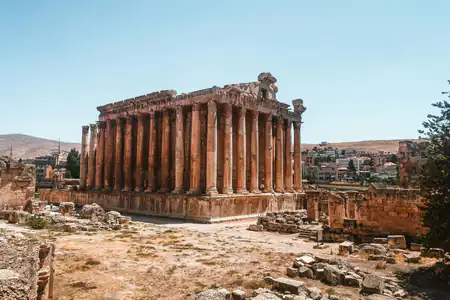
In 1956, twelve Lebanese volunteers — poets, musicians, diplomats, dreamers — looked at the six remaining columns of the Temple of Jupiter in Baalbek and saw something that two thousand years of conquerors had missed. Not ruins. A stage. The tallest columns in the ancient world, twenty metres high against the night sky of the Bekaa Valley, their Corinthian capitals still carrying fragments of Roman stonework. The Baalbeck International Festival was born — in a golden age when Beirut was called the Paris of the Middle East.
The voice that came to define the festival belonged to a young woman named Nouhad Haddad. The world knew her as Fairuz. She was twenty-two when she first sang at the temple in 1957, and she was paid one Lebanese pound — almost nothing. The Rahbani Brothers, Assi and Mansour, were already building the musical language that would shape a generation: a blend of traditional Arabic melody with Western orchestral arrangement, of Lebanese mountain folk song with theatrical craft. At Baalbek, this music found its natural amphitheatre.
The festival drew the greatest performers of the twentieth century. Umm Kulthum — the Star of the East, the woman whose four-hour concerts brought the entire Arab world to a standstill — sang in 1966, 1968, and 1970, selling out every time. Ella Fitzgerald filled the Great Court of Jupiter in 1972. Miles Davis played his electric trumpet in 1973. Nureyev and Fonteyn danced on the steps of the Temple of Bacchus. Every summer, Baalbek stopped being an archaeological site and became a living cultural capital.
Then the music stopped. In April 1975, the Lebanese Civil War began — a catastrophe that lasted fifteen years, killed over a hundred and fifty thousand people, and turned Beirut from the Paris of the Middle East into a synonym for destruction. The festival was suspended. The spotlights went dark. Baalbek became a military stronghold: first for the Amal movement, then for Hezbollah, founded there in 1982. Israeli air raids struck the city in 1984. For twenty-two years, the Temple of Jupiter was silent.
The columns stood. No audience, no purpose, waiting with no guarantee that what they were waiting for would ever return. And the question hanging over all of Lebanon — whether the dream of a country where cultures met and made music together had been permanently shattered by war — found its symbol in those six stone pillars, standing alone against the sky.
But it returned. In 1997, the Russian cellist Mstislav Rostropovich — a man who had survived Soviet censorship, sheltered the writer Solzhenitsyn in his own home, and played Bach at the foot of the Berlin Wall the night it fell — walked onto the steps of the Temple of Bacchus and played for twenty-five hundred people. They say third time's the charm — but in Baalbek, the count works differently. War silenced it, bombs wounded it, a pandemic shut it down — and every single time, the music came back louder.
In 2006, bombs fell three hundred metres from the temples. Cancelled. Came back. During the pandemic, the festival streamed online and reached seventeen million viewers. In 2024, Israeli strikes cancelled the season again. In July 2025, it returned under the theme 'Voice of Resilience' with Carmen on the ancient Roman stage. Each interruption deepened its meaning. Each return proved what those six columns have been proving for two thousand years: what endures is not what is shielded from destruction, but what is rebuilt after it.