
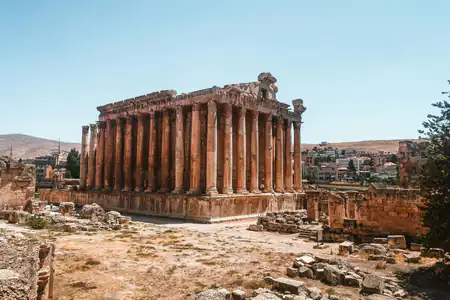
There's a Roman temple in Lebanon that's bigger than the Parthenon — and almost nobody talks about it. The Temple of Bacchus at Baalbek stands thirty-one metres tall, with columns nearly double the height of Athens' most famous building. Built around 150 CE, it's the best-preserved Roman temple on Earth. The adventurer Richard Halliburton, exploring in the 1930s, called it 'the Court of Happiness' — a name locals had used for centuries. But happiness doesn't capture what happened here.
The doorway gives it away. Rising thirteen metres high, it's been called the most ornate entrance in ancient architecture. Every surface is carved with grapevines, dancing women with wild hair — the maenads, ecstatic followers of the wine god Dionysus. Look closer and you'll find poppies threaded through the vines. Wine. Grain. Poppies. These were the three sacred substances of ancient mystery cults, carved into the entrance like a warning: what happens inside this building will change you.
This was a temple to Bacchus — the Roman name for Dionysus, god of wine, madness, and rebirth. The worship here wasn't prayer. It was initiation. Candidates fasted for ten days, then entered at night in purple robes and ivy crowns. Inside, a long hall lined with carved columns led to the adytum — the innermost sanctuary, raised above the floor, open only to initiates. Beneath it ran a hidden underground chamber where priests whispered prophecies to the worshippers above.
The ritual's climax was a death. Not symbolic in any comfortable sense. The initiate became Bacchus — a god who, according to myth, was torn apart by the Titans as an infant, devoured, then brought back to life by Zeus. Priests wearing Titan masks surrounded the kneeling candidate. Paintings from Pompeii's Villa of the Mysteries show a winged figure striking a bare back with a whip. This wasn't punishment. It was the shattering of the old self — the death that comes before rebirth.
Then came the wine — the blood of the god. Ancient wine was weaker than what we drink today, so scholars think it was spiked with herbs, honey, and possibly opium from those poppies on the door. The initiate drank, and the self dissolved. Then the moment everything had built toward: resurrection. Broken and weeping, the candidate was 'restored to life amidst great rejoicing.' The Greek word for this was ekstasis — literally, 'standing outside yourself.' It's where we get the word ecstasy.
But the god here wasn't purely Greek or Roman. Long before Rome, Phoenicians worshipped a dying-and-rising god on this ground — Adonis, from a Canaanite word for 'lord.' Every spring, the nearby river runs red with iron sediment from the mountains. The ancients saw their god's blood. When Rome arrived, they layered Bacchus onto Adonis — two dying gods, one temple, and a truth every culture in this valley reached on its own: the deepest mystery isn't life or death, but the crossing between them.
The temple still stands. Its doorway still bears its grapevines and poppies. The crypt still runs in darkness under the floor where initiates knelt. No one has worshipped here in sixteen centuries, but it outlasted every empire that claimed it — Roman, Byzantine, Arab, Ottoman, French. Stones don't care about empires. They were carved by hands that believed they were shaping a doorway between worlds. And doorways, even abandoned ones, still hold the shape of what once passed through them.