
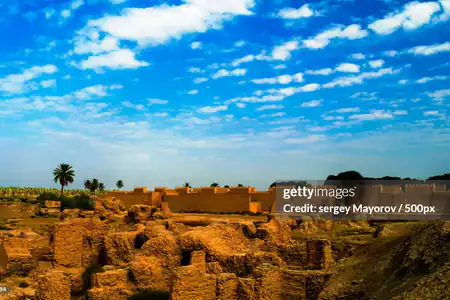
Alexander the Great had conquered everything between Greece and India by the age of thirty-two. Never lost a battle. Not one. In the spring of 323 BCE, he was heading back to Babylon — the ancient city in modern-day Iraq — when a group of Babylonian priests rode out to warn him: do not enter from the west. Disaster was coming. Alexander tried to circle around, but the swamps blocked his army. So he walked right through the western gates anyway. He had eleven days to live.
He wasn’t there to rest. Babylon was his new capital, and he was already planning his next conquest — a massive invasion of Arabia, with eight hundred ships being built in the harbor. He was receiving ambassadors from North Africa, Italy, even Spain. The man had built the largest empire in history, and he wasn’t done. Then, on May 29th, he went to a drinking party at his friend Medius’s place. He drank heavily. By morning, he had a fever.
The court records read like a hospital chart. Days one and two: still working, giving orders for the fleet. Day three: he bathed and made offerings, but the fever wouldn’t break. Day four: too weak to stand, carried on a stretcher. Day five: moved near the river, hoping cool air would help. Day six: the fever spiked. He could barely talk. Day seven: his officers came in and he recognized them, but couldn’t form words. Just his eyes, moving from face to face.
On the eighth day, his soldiers forced their way in. They’d heard he was already dead and that the generals were hiding it. These were the men who’d charged into battle beside him across Persia, Egypt, Afghanistan, and India. They lined up and filed past his bed, one by one. Alexander couldn’t speak. He couldn’t move. But as each soldier passed, he lifted his head and looked at them. That was all he had left. The greatest conqueror in history said goodbye to his army with nothing but his eyes.
He died June 10 or 11, 323 BCE, at thirty-two. Nobody knows what killed him — the debate has lasted two thousand years. Ancient sources blamed poison. Modern doctors suggest typhoid, malaria, even heavy drinking. The wildest theory came in 2018: a researcher proposed he had an autoimmune condition that left him paralyzed but conscious. His body didn’t decompose for six days — the ancients called it proof he was a god. The researcher’s take? He wasn’t decomposing because he wasn’t dead yet.
His last words might be the most expensive sentence ever spoken. Asked who should inherit his empire, he either said ‘to the strongest’ or ‘to Kraterus’ — one of his generals. In Greek, those phrases sound almost identical, and from a man who could barely whisper, no one could tell which he meant. What followed was forty years of war. His mother, his wife, and his infant son were all murdered. The empire he’d spent thirteen years building was torn apart in a generation.
One of his generals stole the body and took it to Egypt, where it sat in a golden coffin in Alexandria for centuries. Julius Caesar visited the tomb. Augustus accidentally broke the nose off the mummy. Then, around the fourth century, the tomb vanished. No one has found it since. The palace where Alexander took his last breath is a crumbling field of mud brick south of Baghdad. The greatest man of the ancient world died in the greatest city of the ancient world. Both are ruins now.