
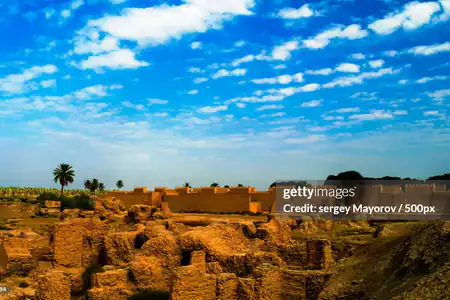
Nebuchadnezzar II didn't just rule Babylon — he rebuilt it from the ground up. Massive double walls wide enough for chariots. The legendary Ishtar Gate. Temples, palaces, canals, a stone bridge over the Euphrates. And on every brick, he stamped his name. Archaeologists have found hundreds of thousands. You can hold one in the British Museum, run your finger over the ancient script: “Nebuchadnezzar, king of Babylon.” He wasn't just building a city. He was trying to make his name permanent.
Then came the dream. A tree so tall it touched the sky, visible from every corner of the earth, giving shelter to every bird and beast. Then a voice from heaven commanded: cut it down. Leave only the stump, bound in iron and bronze. Let its mind become that of an animal. The prophet Daniel — a Jewish exile serving at the Babylonian court — was called to interpret. He wished the dream was about someone else. It wasn't. The tree was Nebuchadnezzar himself. And the sentence had already been passed.
Daniel begged the king: change your ways, show mercy, and maybe God will let this pass. Twelve months went by. Nothing happened. Then one evening, the king walked onto the rooftop of his royal palace — the same palace whose ruins still stand today — and looked out over the skyline he had built. “Is not this great Babylon,” he said, “that I have built by my mighty power, for the glory of my majesty?” Before the words had left his lips, a voice fell from heaven: the kingdom has departed from you.
What happened next sounds impossible — but psychiatrists have documented it in modern patients. The king dropped to all fours. He ate grass like cattle. His hair grew long and matted. His nails curved into claws. For seven years, the most powerful man alive lived as an animal in the open fields. The Bible never explains who ran the empire while he was gone. That silence is deafening — seven years of nothing, as if someone had erased the king from his own kingdom.
Here’s where it gets strange. In 1952, a scroll fragment turned up in a cave by the Dead Sea. It told nearly the same story — a Babylonian king struck mad for seven years, healed by a Jewish holy man — but named a different king: Nabonidus, who ruled decades after Nebuchadnezzar. And Nabonidus actually did abandon Babylon and vanish into the Arabian desert for ten years. Nobody knows why. Many scholars now believe the madness story was originally his, later pinned on the more famous king.
After seven years, Daniel says, the king looked up at the sky — and his mind came back. He praised the God of heaven, his advisors restored him to the throne, and his power grew even greater than before. It reads like a happy ending. It wasn’t. He died in 562 BCE. His son lasted two years before being murdered in a palace coup. Within twenty-three years of the great king’s death, Babylon itself fell to Cyrus of Persia. The man who stamped his name on every brick couldn’t stamp it on time.
But here’s the final twist. The empire crumbled. The dynasty vanished. The city turned to dust. But those bricks — hundreds of thousands of them — are still here. You can walk into the British Museum or the Pergamon Museum in Berlin, hold one in your hand, and read the name Nebuchadnezzar pressed into wet clay twenty-six centuries ago. He wanted to own everything. In the end, he left behind the one thing nobody expected — not a kingdom, not a dynasty. Just a brick. And somehow, that was enough.