
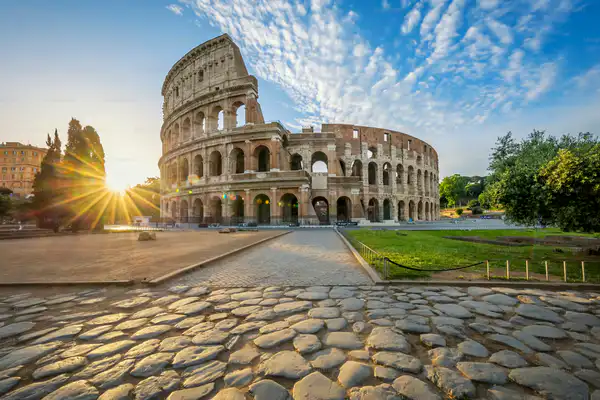
In the early eighth century, an Anglo-Saxon monk named Bede — known to posterity as the Venerable Bede, the father of English history — composed a collection of writings that included what would become the most famous prophecy ever attached to a building. Writing from his monastery at Jarrow in the remote north of England, a man who had likely never seen Rome penned words that would echo across thirteen centuries: "Quamdiu stabit Colisaeus, stabit et Roma; quando cadet Colisaeus, cadet et Roma; quando cadet Roma, cadet et mundus." While stands the Colosseum, Rome shall stand; when falls the Colosseum, Rome shall fall; and when Rome falls, the world shall fall.
The prophecy is actually attributed to Bede by later medieval sources, and scholars debate whether he originated it or was merely recording an already ancient tradition. But its power was undeniable. For medieval pilgrims who traveled enormous distances to visit Rome — the Eternal City, the seat of Christendom, the center of the known world — the Colosseum was not merely an impressive ruin. It was a cosmic barometer. Its physical condition was believed to reflect the spiritual and temporal health of civilization itself.
This belief had profound practical consequences. Throughout the Middle Ages, the Colosseum was systematically pillaged for building materials. Its travertine blocks were carted away to construct palaces, churches, and bridges across Rome. The great Roman noble families — the Frangipane, the Annibaldi — built fortress towers into its arches, converting the amphitheatre into a medieval stronghold. Earthquakes in 847 and 1349 toppled entire sections of the outer wall, and the fallen stones were hauled away for reuse. By the Renaissance, roughly two-thirds of the original structure had been stripped.
Yet Bede's prophecy may have been precisely what saved the remaining third. As the words became widely known and deeply believed, a growing unease developed among Rome's leaders about allowing further destruction. If the Colosseum fell, so would Rome — and so would the world. In 1749, Pope Benedict XIV made the decisive intervention: he declared the Colosseum a sacred site, consecrated to the memory of Christian martyrs believed to have perished in the arena. He erected Stations of the Cross within its walls. The stone-robbing stopped. What remained was now protected by the full authority of the Church.
Lord Byron immortalized the prophecy in Childe Harold's Pilgrimage in 1818, standing among the moonlit ruins and meditating on the passage of empires. For Byron, the Colosseum's decay was itself sublime — a monument more beautiful in ruin than it could ever have been intact, because its broken arches spoke of the impermanence of all human power. His verses made the Colosseum the essential stop on the Grand Tour and cemented its image in the Romantic imagination.
The prophecy proved self-fulfilling in the deepest sense. Because people believed the Colosseum's survival was linked to the fate of civilization, they eventually acted to ensure its preservation. The ruin that stands today — battered, partial, yet magnificently defiant — endures not despite Bede's words but because of them. In an age when Rome has become the capital of a modern nation and the world has not ended, the Colosseum still stands, and Bede's prophecy still whispers from its stones.