
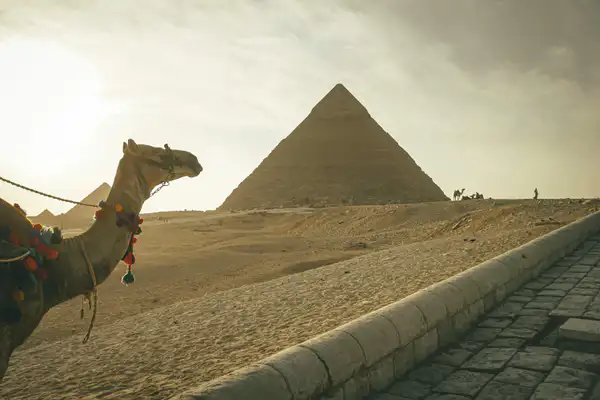
Summer of 1798. Napoleon Bonaparte (not yet emperor, just a young general with an ambition bigger than France) landed in Egypt with an army and 167 scholars, scientists, and artists. They would catalog an ancient civilization and produce the famous Description de l'Egypte. But it was Napoleon's private encounter with the Great Pyramid that would haunt him to the grave.
According to accounts from his own officers, Napoleon insisted on spending a night alone inside the King's Chamber — the granite room buried deep within millions of tons of stone at the heart of the Great Pyramid. His aides protested. A commanding general does not lock himself in a dark tomb. But Napoleon would not be refused. He entered with torchbearers, reached the chamber, and ordered every flame extinguished.
Picture it: a man alone in a chamber where no light penetrates and no air stirs. Darkness so total it has weight. A silence four thousand years old pressing against your eardrums. The only sound is your own heartbeat ricocheting off granite walls that were ancient when Rome was mud huts. The cold mineral air fills your lungs like you're breathing stone itself.
When Napoleon emerged the next morning, witnesses described him as visibly shaken, his face drained of color. An aide asked what had happened. Napoleon began to speak, then stopped himself. 'You would never believe me,' he said quietly, and refused to say another word. For the rest of his life, he kept silent. Not as general, not as emperor of half of Europe.
They say still waters run deep — but the Great Pyramid's silence runs deeper than any human lifetime. Some speculated Napoleon had seen a vision of his future: coronation, conquest, and perhaps Waterloo and the lonely exile waiting on St. Helena. Others whispered he had encountered something inside that pyramid that language simply cannot carry.
The most dramatic version comes from St. Helena, 1821. Napoleon (now a dying exile, stripped of everything) was asked one last time about the night in the pyramid. He reportedly raised himself from his deathbed, eyes burning, and opened his mouth to speak. Then he shook his head slowly. 'No,' he whispered. 'What is the use? You would never believe me.' He died shortly after, carrying the secret into the dark.
The story is now inseparable from the pyramid itself. Napoleon was neither the first nor the last to report strange experiences in the King's Chamber. Modern visitors describe disorientation, altered perception, and awe that has no rational name. The precise proportions, the resonant granite, the sheer weight of millennia pressing down — there is no other place like it on Earth. And whatever it told Napoleon, he took it with him.