
From anywhere in the ancient city of Petra, you can see the same thing: a small white dome, like a pearl, sitting on the highest peak in the desert. It rises 1,353 meters above the ground, glowing against the red sandstone as if someone left a lantern up there so nobody would lose the way. The mountain is called Jabal Harun in Arabic, Mount Hor in Hebrew. And the man supposedly resting beneath that dome is Aaron: Moses's older brother, Israel's first High Priest, and a prophet honored equally in the Torah, the New Testament, and the Quran.
Third time's the charm, the saying goes — and here, three religions point to the same grave with the same certainty. There is no other place on earth where Judaism, Christianity, and Islam agree so completely on the identity of a dead man. Since the first century AD, when the historian Josephus described Aaron's death on a mountain near the ‘metropolis of the Arabians,’ pilgrims of every kind have climbed this slope: kings and shepherds, monks and muezzins, Byzantine processions and solitary seekers.
Aaron's death is told in the Book of Numbers with the devastating simplicity the Bible saves for its most sacred moments. God told Moses: take your brother and his son Eleazar up the mountain. Strip Aaron of his priestly garments and put them on Eleazar. Aaron will die there. Moses obeyed. On the summit, he removed the breastplate set with twelve stones, the blue robe hemmed with golden bells, the turban inscribed ‘Holy to the Lord.’ Aaron stood before his God stripped of his office — just a man, 123 years old, at the end of his life. And there he died.
All Israel mourned him for thirty days — longer than they mourned Moses himself. The Talmud explains why: Moses was the prophet of truth, fierce and uncompromising. But Aaron was ‘ohev shalom v’rodef shalom’ — a lover of peace and a pursuer of peace. When two men quarreled, Aaron would visit each one separately and say: ‘Your friend regrets it and wants to make up.’ When they met, they would embrace, each believing the other had taken the first step. Aaron built peace out of kind little lies, and people loved him for it.
In the Quran, Harun is mentioned twenty times by name — a prophet and messenger chosen by Allah when Musa asked for a companion to confront Pharaoh. But there is one crucial difference from the Torah: the Golden Calf. The Bible implies Aaron helped build the idol. The Quran clears him completely. Harun resisted the idolatry, pleaded with the people, but the mob — stirred up by a figure called al-Samiri — nearly killed him. In Islam, Harun is not the priest who wavered but the prophet who chose unity over violence.
Between 1997 and 2005, Finnish archaeologists from the University of Helsinki excavated the summit and uncovered an entire world: a basilica church with mosaic floors dedicated to Saint Aaron, a hostel for pilgrims, storerooms and courtyards. A papyrus document from AD 573 mentions ‘the Monastery of our Lord the Saint High-Priest Aaron.’ Beneath the Byzantine layers, they found Nabataean remains — traces of worship that predated all three religions by centuries. The mountain was sacred long before anyone called it Aaron's.
The current shrine was built around 1363 by the Mamluk sultan Muhammad ibn Qalawun. It is small, brilliantly white, and almost defiantly simple — as if the builders knew no ornament could compete with the mountain and the sky. Inside sits a mihrab facing Mecca and a cenotaph draped in green cloth. When twentieth-century travelers lifted the carpet, they found colored marble fragments and mosaic cubes underneath — the ghost of the Byzantine chapel that held the summit before the mosque.
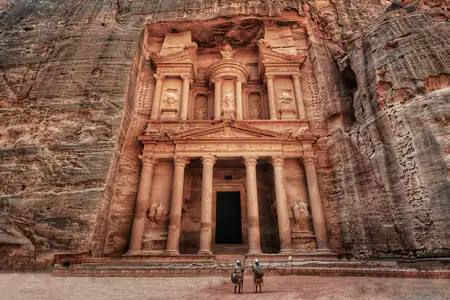
The trail to the top takes four to six hours. No shade, no water. But when you arrive, everything is forgiven. All of Petra unfolds beneath your feet: the Treasury gleaming at the mouth of the Siq, the Royal Tombs, the Roman columns. At sunrise the stone burns red and amber, and the silence is so total you can hear your own heartbeat. Aaron died here, or maybe he didn't. But for three thousand years, people have climbed this mountain to honor a man who chose peace over truth — and at the summit, they find exactly what he spent his whole life trying to give.