
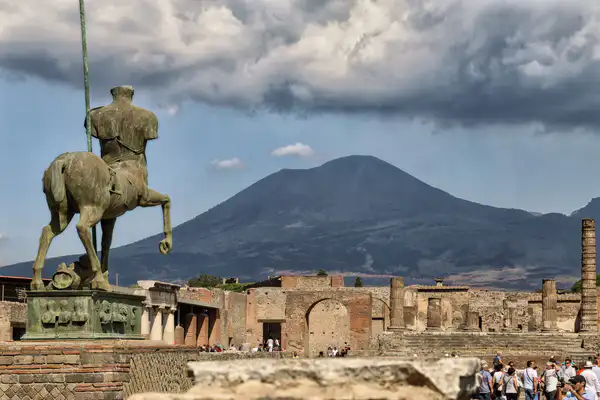
On the afternoon of August 24, 79 AD, Pliny the Elder was working at his villa in Misenum, across the Bay of Naples. He was fifty-five years old, commander of the Roman imperial fleet, and the author of Naturalis Historia — an encyclopedia of the entire natural world in thirty-seven volumes. His sister called him to the terrace. A strange cloud was rising from across the bay, shaped like a stone pine tree: a tall trunk of smoke shooting upward, then spreading flat at the top. No one knew yet that Mount Vesuvius, silent for centuries, was about to destroy everything in its path.
Pliny's first instinct was pure curiosity — he ordered a small boat prepared to cross the bay and study the cloud up close. But before he could leave, a desperate message arrived from Rectina, a friend who lived at the foot of the volcano. The shore was disappearing under falling rock. Escape was only possible by sea. What started as scientific curiosity became a rescue mission. Pliny ordered the full fleet launched — not one small boat but several warships — and sailed straight toward the eruption that everyone else was fleeing.
When the helmsman begged him to turn back, Pliny gave the response that has echoed through twenty centuries: "Fortes fortuna iuvat" — Fortune favors the brave. He ordered the ship onward. But landing near Rectina was impossible — volcanic debris and a shifting seabed blocked the shore. He diverted south to Stabiae, where his friend Pomponianus had packed a ship but could not launch it against the wind blowing from the volcano.
What followed was an extraordinary display of composure. Pliny bathed, dined, and projected such calm cheerfulness that his terrified hosts were genuinely reassured — or, as his nephew dryly noted, equally impressed by his courage and his total disregard for personal danger. During the night, the courtyard filled with pumice so rapidly that the party was forced to the shore, tying pillows to their heads against the falling stones.
At dawn on August 25, the sky was still black as a sealed room. Pliny, who had long suffered from breathing problems, walked to the beach to check whether escape by sea was possible. The volcanic gases — most likely a pyroclastic surge of sulfur dioxide and carbon dioxide — overcame him. He lay down on a sailcloth, asked for cold water twice, and collapsed. When daylight finally returned two days later, his body was found intact on the beach, looking more asleep than dead.
His nephew, Pliny the Younger, had stayed behind in Misenum. Years later, the historian Tacitus asked what had happened. The two letters the nephew wrote in response became the most famous eyewitness account of a natural disaster in all of ancient literature. Scientists still call massive volcanic eruptions "Plinian" in his uncle's honor. Pliny the Elder died as he had lived — sailing toward knowledge, not away from danger — and his nephew's words ensured that the catastrophe which buried Pompeii would never be forgotten.