
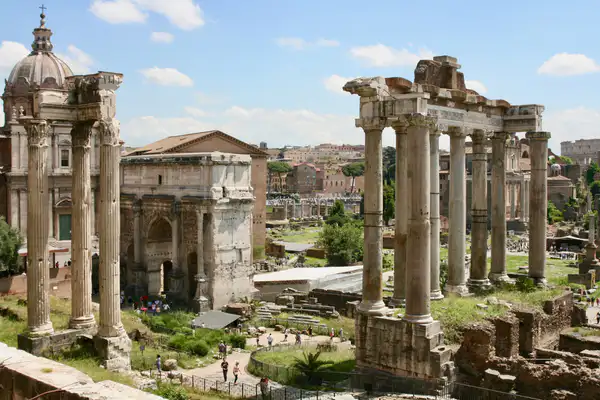
On the Ides of March, 44 BC, Gaius Julius Caesar — conqueror of Gaul, master of the Roman world, dictator perpetuo — was stabbed twenty-three times by a conspiracy of senators in the Theater of Pompey. His body was carried to the Roman Forum, and what followed would blur the boundary between mortal and divine, leaving a mark upon the Forum that can still be seen today.
The public funeral was held in the Forum days after the assassination. Mark Antony delivered his famous eulogy from the Rostra, holding aloft Caesar's bloodstained toga and reading his will, which left generous bequests to the people of Rome. The crowd, seething with grief, erupted into uncontrollable fury. They seized benches and wooden stalls from the surrounding shops, heaped them into a pyre in the middle of the Forum, and cremated Caesar's body on the spot in a spontaneous act of collective mourning that no authority could control.
But the most extraordinary event was yet to come. In July of that same year, Caesar's adopted heir Octavian — the future Augustus — held funeral games in Caesar's honor. On the first evening, a brilliant comet appeared in the northern sky. It blazed for seven consecutive nights, visible to all of Rome, its tail stretching across the heavens like a celestial proclamation. The Roman people needed no persuasion. The comet was Caesar's soul, they declared, ascending to join the gods. They called it the Sidus Iulium — the Julian Star.
Octavian immediately recognized the comet's propaganda value. He placed a star atop every statue of Caesar in Rome. He minted coins bearing the comet's image. He began referring to himself as Divi Filius — "Son of the Divine" — since if Caesar was a god, then his adopted son was the son of a god. The Sidus Iulium became one of the most potent political symbols in history, legitimizing the transformation of the Roman Republic into the Roman Empire.
But darker traditions swirled around Caesar's death. Plutarch records that Caesar's ghost walked the earth, restless and vengeful. The most famous apparition came to Marcus Brutus himself, the noblest of the conspirators. As Brutus camped with his army before the Battle of Philippi in 42 BC, a monstrous spectral figure appeared in his tent at midnight. "Who are you?" Brutus demanded. "I am your evil genius," the phantom replied. "You shall see me at Philippi." The apparition vanished, leaving Brutus shaken to his core.
At Philippi, Brutus was defeated. Rather than face capture, he fell upon his own sword. Ancient writers saw in his death the fulfillment of the ghost's prophecy and the final vengeance of the murdered dictator. Shakespeare would immortalize the scene two thousand years later, but the Romans needed no playwright to feel the chill of the tale.
The Temple of Divus Iulius was built on the exact spot in the Forum where Caesar's body had been cremated. Its ruins still stand today, a low platform near the eastern end of the Forum. Visitors still leave flowers there, an unconscious continuation of a tradition of mourning that has endured for over two millennia.