
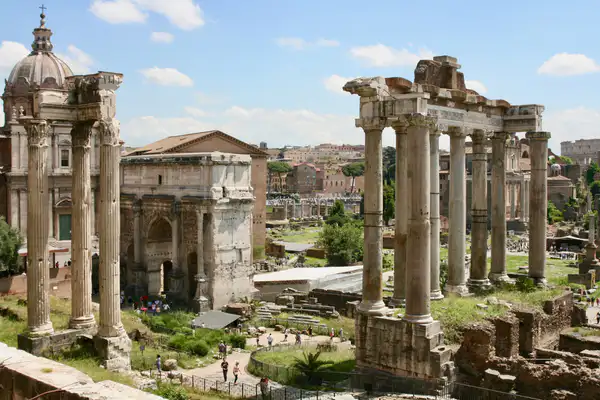
Before Rome was Rome — before the seven hills held temples, palaces, and the fate of half the world — there were two newborns left to die in the flooded waters of the River Tiber. Their mother was a princess. Their father, supposedly, was a god. And the hill where they washed ashore would one day become the heart of the most powerful empire the world had ever seen.
Here’s the backstory. The twins’ mother, Rhea Silvia, was a princess of Alba Longa, a city older than Rome itself. Her uncle Amulius had stolen the throne from her father, King Numitor, and forced Rhea Silvia to become a Vestal Virgin — a priestess sworn never to have children — so no heir could threaten him. When she turned up pregnant, claiming the war god Mars was the father, Amulius panicked. The moment the babies were born, he had them thrown into the river.
But the Tiber didn’t kill them. Swollen with spring rain, the river carried them gently downstream and left them at the base of the Palatine Hill. And here’s where the story gets wild: a she-wolf found the crying babies and nursed them. Not in some meadow — in a cave at the foot of the hill. A woodpecker, sacred to Mars, brought them scraps of food. That image — a wolf feeding two human infants — became Rome’s most famous symbol, stamped on coins and carved in stone for over two thousand years.
Eventually, a shepherd named Faustulus spotted the wolf with the twins and took them home. He and his wife raised the boys as their own. Romulus and Remus grew up tough, fearless, and natural-born leaders. When they finally learned who they really were — princes, not shepherds — they went back to Alba Longa, overthrew their uncle, and put their grandfather back on the throne. Then they set out to build something even bigger: a city of their own.
And this is where the story turns dark. Both brothers wanted to build the city, but they couldn’t agree on where. Romulus wanted the Palatine Hill — the spot where the wolf had saved their lives. Remus wanted the Aventine, a neighboring hill. To settle it, they turned to the gods: whoever saw more vultures in the sky would win. Remus spotted six. Romulus spotted twelve. Both claimed victory. And just like that, a disagreement about real estate turned into something no one could take back.
The ancient historian Livy, writing seven centuries later, tells it like this: Remus, taunting his brother, jumped over the half-built walls Romulus had started tracing around the Palatine. It was a deliberate insult — those walls were sacred. Romulus killed him on the spot. “So perish anyone who crosses my walls,” he said. Other ancient writers blame the killing on one of Romulus’s men. But the result was the same: Rome was born, and it was born in a brother’s blood.
On April 21, 753 BC — at least according to Roman tradition — Romulus marked out his city’s borders with a bronze plow pulled by a white bull and a white cow, lifting the blade at each spot where a gate would stand. That date became Rome’s official birthday, celebrated for centuries. And in 2007, archaeologists digging beneath the Palatine found a sealed underground chamber decorated with mosaics and seashells — possibly the very cave where the wolf nursed the twins. Some myths, it turns out, leave a footprint.