
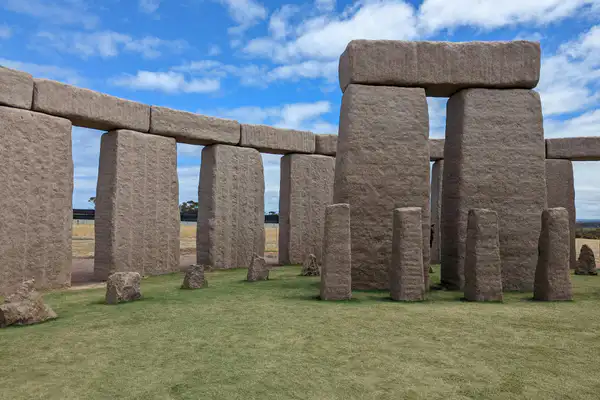
The Saxon warlord Hengist invited 460 British nobles to a peace conference near Salisbury — then slaughtered every last one of them. It was a massacre disguised as diplomacy. The bodies were buried in a mass grave on the plain, and their king, Aurelius Ambrosius, was shattered by grief. He swore he would build a monument so great that the world would never forget what happened there.
Aurelius summoned the finest architects and craftsmen in Britain. None of them could imagine anything worthy of the fallen. Finally, the Archbishop Tremounus told the king there was only one man alive who could help: Merlin, the wizard whose wisdom surpassed that of any mortal. Aurelius sent for him at once.
Merlin's answer stunned the court. In Ireland, he said, on a peak called Mount Killaraus, there stood a ring of colossal stones known as the Giants' Dance. Ancient giants had carried these stones all the way from Africa because the rocks held miraculous healing powers — pour water over them, bathe in it, and any disease would vanish. Nothing on Earth could rival them. Only these stones were worthy of the dead.
The king laughed. Why sail to Ireland for rocks when Britain had plenty of its own? But Merlin cut him short: these were no ordinary stones. Their power was ancient and irreplaceable. Aurelius was convinced. He sent fifteen thousand soldiers, led by his own brother Uther Pendragon — the future father of King Arthur — along with Merlin, to bring the stones back.
The army reached Mount Killaraus and stood in awe before the great circle. Then they set to work — ropes, ladders, raw muscle — and the stones didn't move an inch. They say the third attempt breaks either the obstacle or the man, and by the third day those soldiers were broken. The megaliths seemed rooted by a force beyond anything human.
Merlin watched their struggles with quiet amusement, then stepped forward. Brute strength won't do it, he told them. Only skill can. He set to work using what the medieval writer Geoffrey of Monmouth mysteriously calls "his own arts." Were they machines? Spells? Some blend of engineering and magic? Geoffrey never says. What's certain is that Merlin dismantled every stone with breathtaking ease.
He loaded the stones onto ships, sailed them across the Irish Sea to Britain, and re-erected them on Salisbury Plain in the exact same pattern — a great ring standing over the mass grave of the murdered nobles. Aurelius dedicated the monument, and according to the legend, it has stood there ever since.
Here's what makes this story extraordinary: the inner ring of Stonehenge really is made of bluestones — spotted dolerite and rhyolite — from the Preseli Hills in southwest Wales, about 150 miles away. Geoffrey placed the origin in Ireland instead of Wales, but the core idea is startlingly accurate: Stonehenge's stones were brought from a distant western land, across water, by means we still don't fully understand. Some scholars believe the memory of that epic journey survived in oral tradition for three thousand years before Geoffrey wrote it down, transformed by time into a tale of wizardry and giants.