
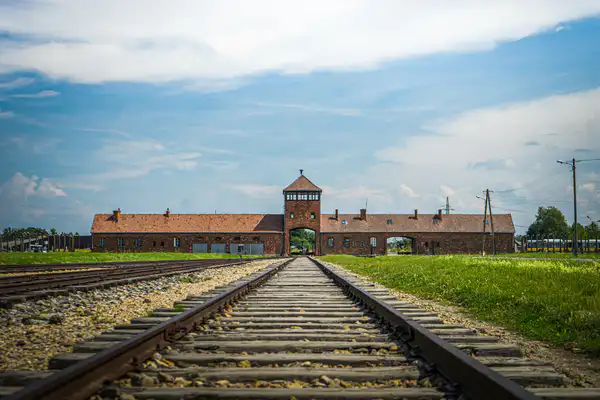
During World War II, the Nazis built Auschwitz-Birkenau — the largest death camp in history — in occupied Poland. About 232,000 children were sent there. More than 200,000 were killed the day they arrived, walked straight from the trains to the gas chambers alongside their parents, their grandparents, their entire families. Not because of anything they'd done. Just because of who they were.
But some children didn't go to the gas chambers. They were pulled aside by Josef Mengele, an SS doctor the prisoners called the "Angel of Death." Mengele was obsessed with twins. When packed trains pulled into the Birkenau platform, he'd walk the lines of terrified families yelling "Zwillinge! Zwillinge!" — the German word for twins — grabbing children from their mothers' arms and sending them to his experiment barracks instead.
About 1,500 sets of twins went through Mengele's barracks. What he did to them wasn't medicine — it was torture in a lab coat. He injected dye into children's eyes trying to change their color. He swapped blood between twins with different blood types. He'd infect one twin with a disease just to compare it to the healthy sibling. When one twin died from the experiments — and many did — he'd kill the other right away to compare their bodies. Fewer than 200 individual twins survived.
Two of those survivors were Eva and Miriam Mozes — ten-year-old twins from the village of Portz in Transylvania, in what's now Romania. They arrived at Auschwitz in 1944. Their parents and two older sisters were gassed the same day. Eva and Miriam were taken to Mengele's barracks, where for months they endured injections, blood draws, and tests they couldn't understand. The injections damaged Miriam's kidneys — damage that would follow her for the rest of her life.
After Soviet troops freed the camp in January 1945, Eva spent the next fifty years living with what Auschwitz had done to her. The nightmares. The rage. The guilt of surviving when her family didn't. These were the wounds the camp left on the people it didn't kill. And then, in 1995, she made a choice that shocked the world more than anything she'd survived.
She forgave the Nazis.
Standing at Auschwitz on the 50th anniversary of its liberation, next to a German doctor named Hans Münch who had worked at the camp, Eva read a declaration of forgiveness out loud and signed it in front of cameras. The backlash was immediate. Fellow survivors were furious. Some said forgiveness wasn't hers to give — that only the dead could forgive, and the dead were silent. Others said she was letting the killers off the hook.
Eva's answer never changed: "I forgive not because they deserve it, but because I deserve it. I deserve to be free of this pain." For her, forgiveness wasn't about excusing what happened. It was about refusing to let Josef Mengele — a man who'd been dead for years — keep controlling her life. "Anger and hatred are the seeds of war," she said. "Forgiveness is the seed of peace." She wasn't telling anyone else to forgive. She was choosing her own freedom.
Eva Mozes Kor died in 2019, at eighty-five, during a return visit to Auschwitz. She'd gone back dozens of times over the decades, walking students and survivors through the same gates, telling her story in the same barracks where she'd been held as a child. People still argue about whether she was right. But her core idea — that forgiveness is something you do for yourself, not for the person who hurt you — is one of the most powerful things to come out of the darkest place on earth.