
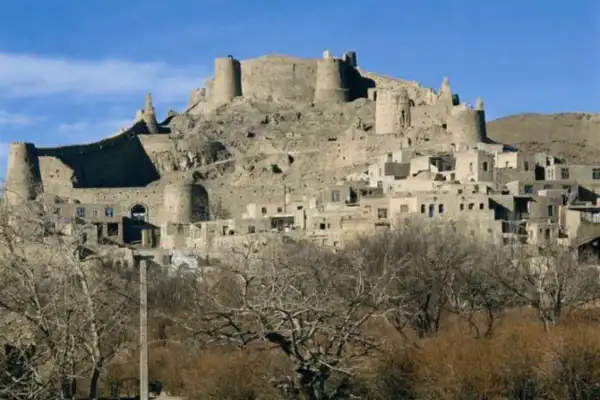
On September 4, 1090, a man walked through the gates of the most heavily guarded fortress in Persia. No army behind him. No sword in his hand. Not a single drop of blood on the ground. The fortress was Alamut — a castle built on a blade of rock two hundred meters above a valley so remote that mapmakers wouldn’t get it right for another eight centuries. The man was Hassan-i Sabbah. And what he pulled off that night might be the most brilliant covert takeover in medieval history.
Hassan was born around 1050 in Qom, in what’s now Iran, and grew up obsessed with learning — philosophy, math, astronomy, anything he could get his hands on. Then a local preacher introduced him to Ismaili Islam, a branch that opposed the Seljuq Turks — the powerful Turkish empire controlling most of the Middle East. Hassan converted and pledged himself to the Fatimid Caliph in distant Cairo. Overnight, he became a wanted man. The Seljuq chief minister personally ordered him hunted down.
So Hassan went to Cairo. He studied at its House of Wisdom, won the trust of the caliph, and rose fast. But palace politics caught up — he clashed with the wrong people, got thrown in prison, and was kicked out of Egypt. Shipwrecked on the way home, he survived and made it back to Persia in 1081. Then he did something no one expected. Instead of hiding, he spent the next nine years crossing mountains in disguise, building a secret network of followers with one goal: find an unbreakable fortress.
He found it in the Alamut Valley — a narrow strip of green hemmed in by peaks three thousand meters high, with a single pass that closed half the year. At its center, on a jagged ridge of rock, stood Alamut Castle. Hassan didn’t raise an army. He sent preachers into surrounding villages. He planted converts as guards and servants inside the castle. He moved nearby as a schoolteacher, spending two years earning everyone’s trust. Every piece placed with surgical patience.
That September night, Hassan walked in — already known, already trusted by the very men paid to keep strangers out. The castle’s owner, a lord named Mahdi, was away. When he came back, his own guards and servants answered to someone else. Hassan handed him a draft for three thousand gold dinars — a fortune — as payment for the castle. Surrounded by men who no longer followed him, Mahdi took the money and left. The most feared fortress in Persia had changed hands without a single blow.
Hassan never left Alamut again. For thirty-four years, until his death in 1124, he stayed inside — stepping out of his room just twice, both times only to climb the roof. He built one of the greatest libraries in the Islamic world, expanded into a network of over two hundred mountain fortresses, and trained devoted operatives whose targeted killings made their name — the Assassins — a permanent word in every European language. He lived like a monk and died like a founder of nations.
Hassan didn’t conquer a castle. He made it realize it already belonged to him. And the eagle’s nest that became his home — Alamut, from the old Persian for “Eagle’s Teaching” — never forgot its master. For a hundred and sixty-six years after that September night, no empire on earth could take it back.