
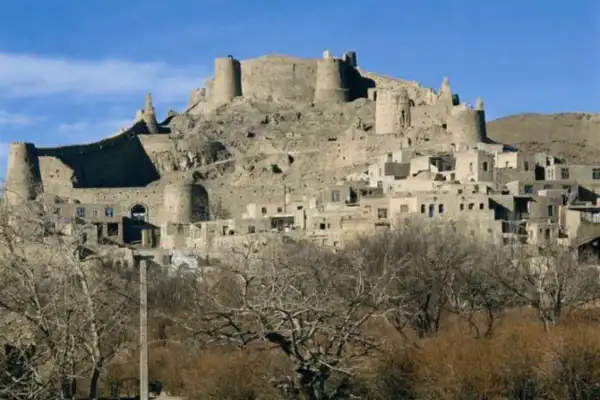
Around the year 840, a ruler named Wahsudan was hunting in the mountains south of the Caspian Sea — a region of Iran so rugged that even Arab armies couldn’t conquer it. Then he saw something that changed everything. A great eagle dropped from the sky and landed on a blade of rock rising two hundred meters above the valley floor. Wahsudan looked at that rock — sheer cliffs on three sides, one narrow approach, a river below — and understood. The bird had just shown him where to build an unbreakable fortress.
He built it. And he named it after the lesson. In the local Daylami dialect, ‘aluh’ meant eagle and ‘amukht’ meant teaching. Aluh amukht — the Eagle’s Teaching. Say it fast, a few hundred times over a few hundred years, and it becomes one word: Alamut. The fortress sat on its rock for two and a half centuries, passing through the hands of local rulers — a perfect stronghold in a hidden valley, known to almost no one.
Then, in 1090, everything changed. A fugitive preacher named Hassan-i Sabbah — leader of a revolutionary branch of Shia Islam called the Ismailis — slipped into the valley and captured the castle without spilling a drop of blood. He turned Alamut into the headquarters of a movement that would terrify the medieval world for nearly two centuries. But that’s not the strangest part of the story.
In Islamic numerology, every Arabic letter carries a numerical value. Medieval scholars discovered that when you add up the letters of the old Daylami name — Aluh amukht — they total 483. The year Hassan captured Alamut? 483 in the Islamic calendar. The name Wahsudan gave his castle two hundred and fifty years before Hassan was born contained the exact date of the event that would make it legendary. Whether that’s coincidence or destiny depends on what you believe. The Ismailis had no doubts.
In 1256, the Mongols came. They tore down the walls, burned the legendary library, and massacred the garrison. The valley — already cut off from the world by mountains and a gorge that floods shut half the year — slipped back into silence. For nearly seven centuries, Alamut existed only as a legend: the setting for Marco Polo’s wild tales of drugged assassins and paradise gardens, a name used by European writers who had never seen the place and had no clue where it actually was.
In 1930, a thirty-seven-year-old Englishwoman named Freya Stark set out from Baghdad on the back of a mule — camp bed, mosquito net, and a determination to find the Valley of the Assassins. She was a self-taught mapmaker who’d already explored parts of the Middle East most European men were afraid to enter. She crossed mountain passes half-sick with malaria, relying on local guides who each gave different names for the same hill. When she reached the rock, she discovered the official maps were dead wrong — and fixed them herself. Her book brought Alamut back to the world.
Today, about thirty percent of the original fortress survives on its rock above the valley. Visitors climb two hundred meters of steep stairs to find fragments of walls, ruined workshops, and a water channel carved into the cliff by Hassan’s engineers that still works after nearly a thousand years. But the real thing you notice, standing on the summit, isn’t the ruins. It’s the golden eagles. They’re still there, riding the wind above the peaks, circling the same valley Wahsudan hunted twelve centuries ago. The eagle chose well. The lesson endures.