
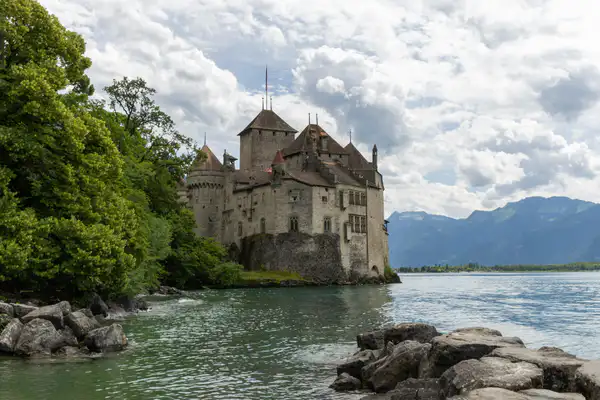
In the year 1530, soldiers of Charles III, Duke of Savoy, seized a man on the road near Geneva and brought him to the Chateau de Chillon. His name was Francois de Bonivard, and his crime was simple: he had spent years working to free the city of Geneva from the political control of the Duke of Savoy, advocating for the city's right to govern itself as an independent republic. For this -- for believing that a city should choose its own destiny -- he was dragged into the underground vaults of Chillon and chained to the fifth pillar from the entrance with an iron ring around his ankle.
The dungeon of Chillon is not a cramped oubliette but a vast underground hall, its vaulted ceiling supported by massive stone pillars that march into darkness like the columns of a subterranean cathedral. The lake lies just beyond the walls, and Bonivard could hear the water lapping against stone day and night, a sound that never ceased, that marked no hours and distinguished no seasons. He could not see the lake. He could not see the mountains. He could see only the pillar to which he was chained, the stone floor that his pacing feet wore into a visible groove over the years, and the dim light that filtered through narrow slits too high and too small to offer any view of the outside world.
For six years he lived in this condition. Six years of pacing the same circle around the same pillar, of hearing the water but never seeing it, of marking time only by the changing quality of the cold -- the bone-deep chill of winter, the slightly less piercing cold of summer in a vault that never felt warmth. He was not tortured in any dramatic sense. He was simply forgotten. Left to pace and think and pace again until his footsteps wore a path into the stone floor that is still visible today, a shallow groove around the base of the fifth pillar that testifies more eloquently than any document to what six years of captivity does to a human being.
In 1536, Bernese troops advancing on the Chateau de Chillon breached its walls and found Bonivard still alive in the dungeon, still chained to his pillar. They struck off his chains and led him out into daylight -- daylight he had not seen in six years. The story goes that Bonivard stood blinking at the door of the castle, looking out at the lake and the mountains, and felt not joy but a strange reluctance. The dungeon had become his world. The pillar had become his companion. Freedom, when it came, felt almost like another form of displacement.
Nearly three centuries later, in the summer of 1816, a young English poet named George Gordon Byron sailed across Lake Geneva to visit the castle. He descended into the dungeon, touched the pillar, saw the groove worn by Bonivard's feet, and was so moved that he carved his own name into the third pillar -- an act of vandalism that is now itself a protected historical artifact. That night, or shortly after, he wrote The Prisoner of Chillon, a poem that transformed Bonivard from a forgotten political prisoner into a universal symbol of the human spirit's endurance under captivity. Byron gave Bonivard a voice he never had in life, expressing not just the suffering of imprisonment but the more terrible truth that captivity can become its own form of home, that freedom itself can be frightening to a man who has lived without it for too long.
Today visitors descend into the dungeon and walk the same stone floor, and they can still see the groove around the fifth pillar, still touch the iron ring, still read Byron's carved name on the third column. The Chateau de Chillon has many rooms and many stories, but this underground vault is its heart -- the place where history, literature, and the irreducible human experience of suffering converge in a silence that still speaks.