
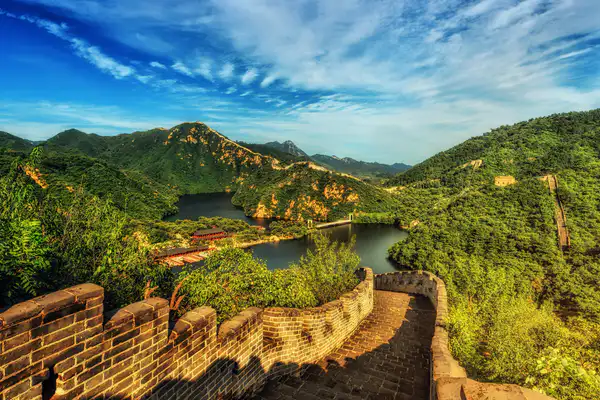
Long before humans drew borders or built kingdoms, a celestial dragon descended from the sky — one of the nine divine sons of the Jade Emperor, the supreme god of the Chinese heavens. It began crawling across the mountains of northern China, and its body was so massive that every curve of its spine pressed a new ridge into the rock. Behind it, the dragon left an invisible trail of cosmic energy burned into the earth.
The dragon crossed thousands of miles of mountain ranges until, finally exhausted, it stopped and fell into a deep sleep. Its body lay stretched across the peaks like a river of scales. The earth remembered every turn, every bend. The cosmic energy it left behind kept burning beneath the surface like an underground fire that never goes out.
Centuries later, China's first emperor — Qin Shi Huang, the man who unified a land torn apart by war — decided to build a wall across the northern border to protect his empire from nomadic raiders. His geomancers, masters of feng shui, studied the terrain and made a stunning discovery: a line of cosmic energy already ran through the mountains, tracing a perfect path.
They told the Emperor: "The dragon has already marked the way. Build upon its spine, and the wall will carry the dragon's power — no enemy from the north will be able to cross it." They say that fate writes its plans before men are born to read them. Here, fate had written its plan not in the stars, but in stone and soil.
And so the wall was built — not by human design alone, but following the cosmic geography laid down by heaven itself. This is why the Great Wall snakes along mountain ridges instead of taking easier paths through valleys. This is why, seen from above, it moves like a living thing — because it follows the contours of a sleeping dragon.
The Chinese call this pattern "龙脉" (lóng mài) — the dragon vein. In Chinese geomancy, dragon veins are lines of cosmic energy that flow through the landscape like invisible rivers of life force. The Great Wall sits upon the most powerful dragon vein on Earth.
Some mystics say the dragon is not dead — only sleeping. And that the wall serves not just to keep invaders out, but to keep the dragon pinned to the earth. Should the wall ever be completely destroyed, the dragon would wake — and the consequences would reshape the world.
This is why, they say, every dynasty that let the wall crumble eventually fell itself. The wall and the dragon are one. Protect the wall, and you protect the nation. Let it decay, and you invite catastrophe with your own hands.