
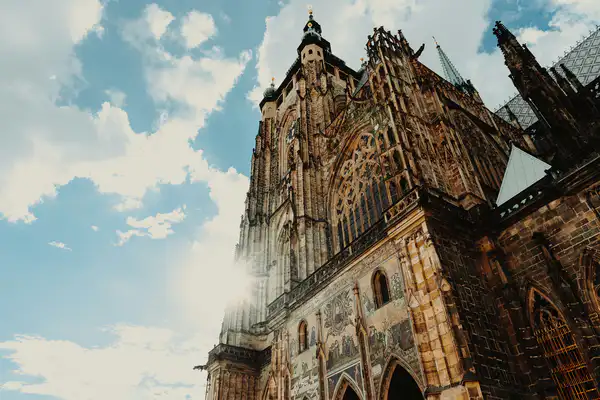
Most emperors wanted bigger armies. Rudolf II wanted to turn lead into gold. In 1583, he did something no one expected — he moved the entire capital of the Holy Roman Empire from Vienna to Prague. Not for politics. Not for war. He wanted to build the greatest laboratory Europe had ever seen, right inside Prague Castle.
Rudolf was brilliant, possibly unstable, and completely consumed by alchemy — the ancient belief that you could transform cheap metals into gold if you found the right formula. He was chasing two things: the Philosopher’s Stone, a legendary substance that supposedly made the transformation possible, and the Elixir of Life, which promised immortality. He spent staggering amounts of money recruiting every alchemist, astronomer, and mystic in Europe to come work for him.
The first big name to arrive was Edward Kelley, an Englishman with a shady past and a bold claim: he owned a mysterious red powder that could turn mercury into gold. Rudolf gave him a tower in the castle and a blank check. Kelley even staged a live demo for the court — and somehow pulled it off. But when he couldn’t repeat the trick or deliver the Stone, Rudolf threw him in prison. Kelley died trying to escape, falling from a tower window.
Not everyone at court was a fraud. John Dee, one of England’s sharpest minds, came with Kelley to discuss math, optics, and what he claimed was communication with angels. Tycho Brahe, a Danish astronomer who’d lost part of his nose in a sword duel and wore a metal replacement, became the Imperial Mathematician. His star charts, recorded at the castle, later helped his assistant Johannes Kepler discover how planets actually move — one of the biggest breakthroughs in science.
The castle attracted hundreds of lesser-known figures too. Golden Lane — a row of tiny, colorful houses tucked beneath the castle walls — was packed with alchemists working around the clock. Furnaces glowed through the night. Strange mixtures bubbled in clay pots. The air reeked of sulfur and mercury. Explosions were not uncommon. It was part research campus, part mad scientist’s playground.
Rudolf also built one of the most jaw-dropping private collections in Europe. Paintings by masters like Dürer and Bruegel. “Cabinets of curiosities” — think early museums — stuffed with supposed unicorn horns, strange stones believed to cure poison, and rare plants from distant lands. Precision astronomical instruments. Prague Castle became a place where art, science, magic, and obsession all lived under the same roof.
But the obsession ate him alive. Rudolf grew paranoid and isolated, convinced enemies were closing in. His own brother Matthias forced him off the throne. Rudolf died in 1612, alone in the castle he’d turned into a wonderland — surrounded by his collections but abandoned by everyone. He never found the Philosopher’s Stone. Nobody ever has. But his obsession gave Prague something that lasted: a reputation as the city where the line between genius and madness has always been beautifully blurred.