
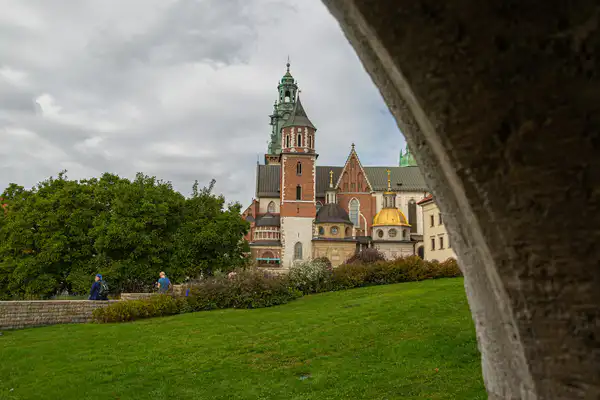
Before Kraków was a capital, before the first stone of Wawel Castle was laid, something lived in the cave beneath the hill. The Poles called it Smok Wawelski — the Wawel Dragon. Scales tougher than iron. Jaws wide enough to swallow a horse. Breath that turned villages to ash. At first it ate livestock — cattle, sheep, whatever it could grab. But when the animals ran out, the dragon demanded something worse: young women, left at the cave mouth like offerings to a god that only knew hunger.
King Krakus — the man who legend says founded the city and gave it his name — was desperate. Every week, another daughter was led to the cave at sunset. By morning, nothing was left but scorched ground and silence. So the king made an offer: kill the dragon, and you get half my kingdom and my daughter's hand. Warriors came from everywhere — German swordsmen, French knights, Hungarian mercenaries. One by one, they marched into that cave with their best weapons. None of them walked out.
Then a cobbler's apprentice named Skuba stepped forward. He wasn't a soldier — he made shoes for a living. And his plan sounded ridiculous: he asked the king for a dead sheep, a pile of sulfur, and some strong thread. The entire court laughed. A shoemaker against a dragon? But Krakus had watched every champion in Europe fail, so he figured — why not let the kid try.
Skuba worked through the night. He hollowed out the sheep, packed it full of sulfur, and sewed it shut with his cobbler's thread — stitching so tight you'd swear the animal was still breathing. Just before dawn, he placed the fake sheep right at the entrance of the dragon's cave. Then he backed away and waited.
The dragon came out at first light, head swinging, nostrils wide. It spotted the sheep, snapped it up in one bite, and swallowed it whole. For a second — nothing. Then the sulfur hit the fire in the dragon's gut. The beast let out a roar that shook the walls of Wawel Hill and sent every bird along the Vistula — Poland's biggest river — scattering into the sky. The dragon was burning from the inside out, and there was only one thing it could do: run to the water and drink.
It drank. And drank. And drank. The dragon swallowed so much river water that the Vistula actually dropped along its banks. But here's the thing about sulfur — water doesn't put it out. The more the dragon drank, the worse it got. Its belly swelled until the scales started cracking open. And then, right there on the riverbank, the Wawel Dragon exploded. Scales and bone everywhere. The monster that no army could kill was destroyed by a dead sheep and a bag of chemicals.
Kraków was free. Skuba married the princess — not for being the strongest or the bravest, but for being the smartest person in the room. Today, a bronze dragon statue stands at the base of Wawel Hill, and here's the best part — it breathes real fire every few minutes while tourists take selfies. The dragon's cave, Smocza Jama, is still open. Walk down a spiral staircase into the cool dark, and locals swear that on quiet nights, you can still catch a hint of sulfur in the air.