
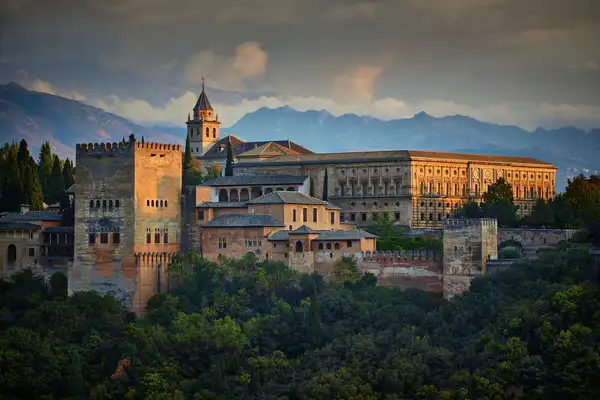
The kingdom that died on January 2, 1492, had been destroying itself for a decade. The Nasrid dynasty ruled Granada for two hundred and sixty years and built the Alhambra into the most beautiful palace on earth. Then Sultan Abu'l-Hasan fell for a Christian captive called Soraya and cast aside his wife Aixa and their son Boabdil. Aixa — titled 'the Free Woman' — escaped prison by climbing down knotted scarves, allied with the Abencerraje clan, and helped Boabdil seize the Alhambra from his own father in 1482. The emirate split in two. Ferdinand and Isabella watched from across the border like surgeons studying a patient already dying.
They say God helps those who help themselves. The Nasrids couldn't even stop destroying each other. Ferdinand's genius wasn't military — it was patience. When young Boabdil was captured at the battle of Lucena in 1483, Ferdinand didn't execute him. He released him, made him a Castilian vassal, and sent him back to keep fighting his own family. While the Nasrids tore themselves apart, Ferdinand picked off their cities one by one: Ronda in 1485, Málaga in 1487, Baza and Almería by 1490. By 1491, Boabdil held only Granada itself — one city, surrounded.
Ferdinand and Isabella built an entire city called Santa Fe on the plain below the Alhambra — a permanent camp of stone that told Granada: we are not leaving. The Treaty of Granada, signed November 25, 1491, promised everything. Muslims could keep their mosques, their laws, their judges. No one would be forced to convert. Those who wanted to leave could go freely. On paper, it was astonishingly generous. In reality, every single promise would be broken within seven years.
On the morning of January 2, 1492, Boabdil rode down from the Alhambra for the last time. He passed through the Gate of Seven Floors and asked that it be sealed behind him forever — it stayed bricked up for three centuries. At the River Genil, he handed the keys to Ferdinand with a final flash of dignity: 'God loves you greatly, Sir. These are the keys of this paradise.' Ferdinand passed them to Isabella, who passed them to Prince Juan, who handed them to the new governor. A silver cross rose on the Alhambra's highest tower. Eight hundred years of Muslim Spain ended in a single morning.
Then came the sigh. Riding south toward the Alpujarras mountains, Boabdil stopped at a windswept pass and turned for one last look. The Alhambra glowed red-gold against the snow-capped peaks. Below it spread Granada — the minarets, the gardens, the river threading through the gorge — the last jewel of a civilization that had given Europe algebra, astronomy, and philosophy. Boabdil looked at everything he had lost, and wept. His mother Aixa, riding beside him, delivered perhaps the most devastating line a parent has ever spoken: 'Weep like a woman for what you could not defend as a man.' The pass has been called the Moor's Sigh ever since.
The promises shattered almost immediately. By 1499, Cardinal Cisneros was forcing mass conversions in Granada. By 1502, the choice was convert or leave. And in history's cruelest coincidence, Columbus — who had watched Boabdil surrender — sailed that August, delayed one day because the harbor was jammed with Jewish refugee ships fleeing their own expulsion decree. The fall of al-Andalus, the expulsion of the Jews, and the discovery of the Americas all came from the same year, the same monarchs, the same fortress.
Boabdil lived another forty years. His wife Morayma died of grief within months. He crossed to Morocco, built palaces in Andalusian style, and reportedly died fighting around 1533 — perhaps the redemption his mother's words had demanded. 'To weep like Boabdil' became a Spanish expression for mourning a loss that was your own fault. And on every arch and wall of the Alhambra, the Nasrid motto still repeats in Arabic what his sigh could not say aloud: Wa la ghalib illa Allah. There is no victor but God.