
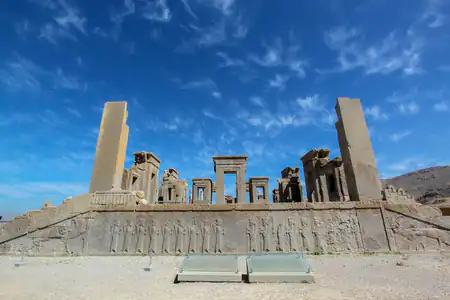
In the 1930s, archaeologists cracked open a wall at Persepolis — the capital of the ancient Persian Empire in modern Iran — and found thirty thousand clay tablets sealed inside. They were accounting records. Who got paid, how much grain, how many workers. Boring stuff. Until someone actually read them. Buried in those receipts was proof that the biggest empire on earth was paying women the same as men for the same work — twenty-five centuries before anyone else even started that conversation.
The tablets cover about fifteen years under King Darius the Great, around 500 BCE. They list workers from across the empire — Persians, Babylonians, Egyptians, Greeks, Indians — thousands of names, each with a job title and pay rate. And hundreds of those names belonged to women. Not slaves. Not servants. Paid workers and supervisors. When a woman did the same skilled job as a man, she got the same pay. Not as a one-off. Across thousands of records, over fifteen years. It was policy.
Here’s where it gets wild. The tablets show that women who had just given birth received extra pay — basically government-funded maternity leave in the fifth century BCE. Not Athens, where women couldn’t own property or leave the house without a man. Not Rome, where women were legally treated like children their entire lives. Persia. The civilization the Greeks called barbaric had built a system to support new mothers that wouldn’t be matched anywhere in the West for over two thousand years.
Then there were the women at the very top. A woman named Irdabama appears across dozens of tablets running massive farming estates, commanding hundreds of workers, and signing off on shipments with her own personal seal — a carved image of a woman sitting on a throne. She traded grain, wine, and livestock at a scale that rivaled governors. No husband or father is ever mentioned approving her decisions. She answered to no one but the king.
But the real power player was Atossa. She was the daughter of Cyrus the Great — the man who built the Persian Empire from nothing. She married three kings in a row. The Greek historian Herodotus, who normally ignored Persian women, wrote that she held “all power” at court. When King Darius needed to choose his heir, Atossa made her move. She argued that her son Xerxes deserved the throne over his older half-brothers. She won. One woman decided who would rule the largest empire on earth.
For centuries, Western scholars looked at Persepolis and saw what they expected — harems, veiled women, and a backward empire. They even labeled one building “the Harem of Xerxes” with zero proof. But the tablets tell a completely different story. Royal women traveled freely between provinces, hosted feasts, managed estates, and controlled serious wealth. They weren’t locked away behind walls. They were running the empire from inside them.
The Greeks wrote the history, so Persia got painted as a land of tyrants ruling over helpless women. The truth sat sealed in a wall for twenty-three centuries, baked hard by the fire Alexander the Great set when he burned Persepolis to the ground. It ended up in Chicago, where a quiet scholar named Richard Hallock spent decades decoding grain receipts that turned out to be the most revolutionary documents in the history of women’s rights. They weren’t grand declarations. They were pay stubs.