
In the seventh century, a warrior king named Songtsen Gampo did something no one had ever done — he united the warring clans of the Tibetan plateau into a single empire. His army was fierce enough to make even the mighty Tang Dynasty of China nervous. And once his kingdom was secure, Songtsen Gampo sent an envoy to the Tang imperial court with an audacious request: he wanted a Chinese princess as his bride.
The Tang Emperor Taizong refused. Tibet was a remote mountain kingdom — why would he send a princess to the edge of the world? But Songtsen Gampo was not a man who accepted no for an answer. When diplomacy failed, he threatened war. When war loomed, Taizong relented. He chose Princess Wencheng, a woman of the imperial clan known for her intelligence, beauty, and deep devotion to Buddhism.
The princess's journey to Lhasa took over two years, crossing some of the most treacherous terrain on Earth — high plateaus, frozen mountain passes, and endless grasslands. She brought with her a staggering dowry: a life-sized golden statue of Shakyamuni Buddha (now the most sacred object in Tibet, still housed in the Jokhang Temple), Buddhist scriptures, Chinese silk, agricultural seeds, and craftsmen skilled in metalwork, papermaking, and weaving.
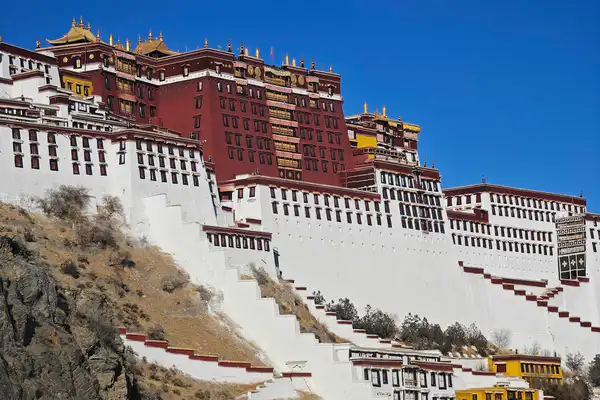
Songtsen Gampo, enchanted by his bride, built the Potala Palace on Red Hill in Lhasa as a wedding gift — a palace worthy of a princess who had crossed the world. Legend says the original palace had nine hundred and ninety-nine rooms, with a meditation chamber at the very top where Wencheng practiced Buddhism.
But the story is far more than a romance. Princess Wencheng is credited with introducing Buddhism to Tibet, alongside the king's Nepali wife, Princess Bhrikuti. She brought Chinese astrology, medicine, and civil engineering. She transformed Tibetan culture so profoundly that she is still worshipped today as a living form of the Green Tara — one of the most important figures in Tibetan Buddhism.
The Tang Dynasty saw the marriage as a diplomatic tool to pacify a dangerous neighbor. But the Tibetans remember it as the moment their civilization truly began. The golden statue of Buddha that Wencheng carried across the mountains remains in the Jokhang Temple to this day, draped in silk and gold, surrounded by butter lamps that have burned continuously for fourteen hundred years.
In modern times, Princess Wencheng has become a political symbol. China points to the marriage as evidence of Tibet's historical connection to China. Tibetans honor her as the woman who brought them the Dharma. Both sides claim her story, each telling it differently.
But perhaps the truest version is the simplest: a young woman left everything she knew, crossed the world for a man she had never met, carried the Buddha with her, and changed a civilization forever. The palace he built for her still stands on the hill above Lhasa.