
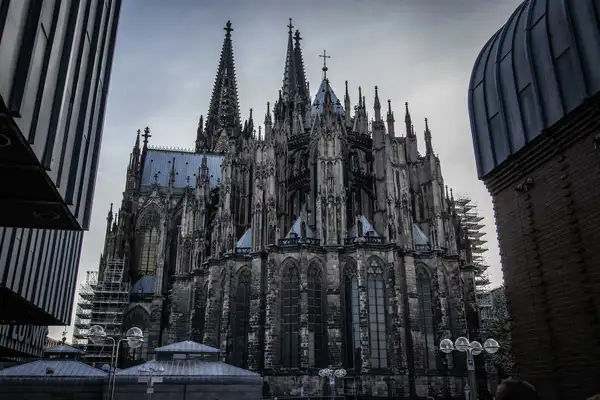
In 1164, a line of armed riders hauled a golden chest out of Milan, over the Alps, and down the Rhine to Cologne. Leading them was Rainald von Dassel, the Archbishop of Cologne and right-hand man to Emperor Frederick Barbarossa. Inside that chest, Rainald claimed, lay the bones of the Three Magi — the Wise Men from the Christmas story who followed a star to Bethlehem and brought gold, frankincense, and myrrh to the newborn Jesus.
How did the bones of three Middle Eastern wise men end up in Italy? The story goes back to the 300s, when Empress Helena — mother of Constantine, the Roman emperor who legalized Christianity — traveled the ancient world collecting sacred objects. She found the Magi's remains in Persia and shipped them to Constantinople. From there, they ended up in Milan, in the Church of Sant'Eustorgio, where they sat for roughly eight hundred years. Nobody touched them — until Barbarossa showed up.
Here's the backstory. Milan had been defying the emperor for years, and in 1162, after a two-year siege, Barbarossa's army took the city. He didn't just conquer it — he leveled it. Walls torn down. Buildings flattened. Citizens scattered. A message to every city in northern Italy: don't challenge the emperor. And the final insult? Rainald grabbed Milan's most sacred treasure — the bones of the Three Kings — and carried them north to Cologne. It was the biggest relic theft of the Middle Ages.
The effect was instant. Pilgrims flooded into Cologne from across Europe. The old cathedral couldn't handle the crowds, so they planned a new one — the Gothic cathedral that still stands today — built to house these bones. They hired a master goldsmith, Nicholas of Verdun. By 1225, he had created the largest golden shrine in the Western world: a chest of gilded silver and copper, over two meters long, studded with over a thousand gemstones and golden figures of prophets, apostles, and kings.
The stolen bones made Cologne rich. Pilgrims needed beds, meals, and souvenirs. The city put three golden crowns on its coat of arms. Epiphany — the day Christians celebrate the Magi's visit to Jesus — became the city's biggest holiday. Cologne's identity was built on these remains: bones taken from a conquered city by a ruthless politician, locked in a golden chest, and worshipped by millions. The holiest city in northern Europe owed everything to the greatest theft it had ever pulled off.
Milan never got over it. For eight centuries, the city asked for its relics back. Finally, in 1903, the Archbishop of Milan convinced Cologne to return a few bone fragments. Those pieces went back to Sant'Eustorgio, where they sit today. But the vast majority never left. They're still inside Nicholas of Verdun's golden shrine, behind the altar of the cathedral that was built to hold them. Eight centuries on, the stolen bones of three legendary kings still draw the faithful to the Rhine.