
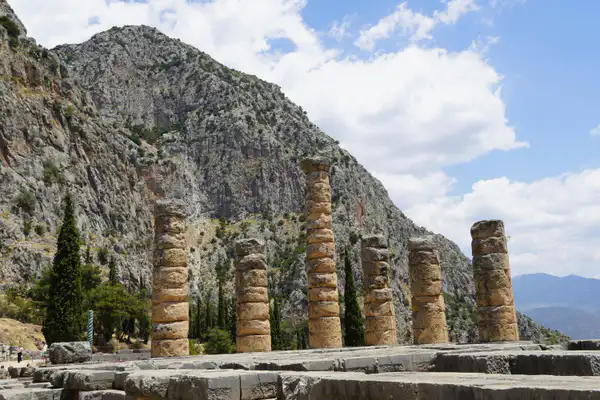
Around 430 BCE, Socrates' best friend Chaerephon made a trip that would change the history of human thought. He traveled to Delphi — the most important oracle in the ancient Greek world, where a priestess called the Pythia channeled the god Apollo — and asked one bold question: "Is anyone wiser than Socrates?" The Pythia's answer was short and stunning: "No one."
When Chaerephon brought the answer back to Athens, Socrates didn't celebrate. He was confused. He knew he wasn't wise — he was just a guy who asked questions, who poked holes in other people's arguments, who freely admitted he didn't have the answers. So how could the most sacred oracle in Greece call him the wisest man alive?
So Socrates did what Socrates always did: he went looking for proof. He tracked down the people in Athens everyone considered wise — the politicians, the poets, the skilled craftsmen — and grilled them. What is justice? What is courage? What do you actually know, and how do you know it?
The results were devastating. Politicians talked about justice but couldn't define it. Poets wrote beautiful lines but couldn't explain what they meant. Craftsmen were brilliant at their trades but assumed that made them experts on everything else. Every single one of them thought they were wise. Not one of them actually was.
And that's when it clicked. The difference between Socrates and everyone else wasn't knowledge — it was honesty. They were all equally clueless about the big questions. But these so-called wise men believed they had the answers. Socrates knew he didn't. That tiny gap — the willingness to say "I don't know" — was the entire difference between wisdom and foolishness.
Here's how Socrates put it: "I am wiser than this man. Neither of us knows anything worth knowing, but he thinks he knows when he doesn't. I at least know that I don't know." It might be the most important idea anyone has ever had — and it boils down to this: the smartest person in the room is the one who knows what they don't know.
That one answer from the Oracle set Socrates on a mission that would define — and ultimately end — his life. He spent the next thirty years questioning everyone in Athens, exposing false confidence and challenging people to actually think. It made him a hero to some and a threat to others. In 399 BCE, Athens put him on trial for "corrupting the youth" and sentenced him to death.
Above the entrance to the temple at Delphi, two words were carved into stone: "Know Thyself." Thousands of people read that inscription and walked right past it. Socrates was the one person who took it seriously enough to build a life around it. Twenty-five centuries later, we're still trying to catch up.