
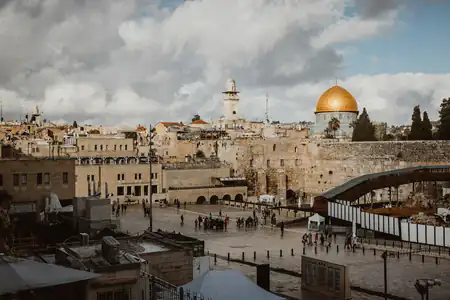
Underneath the golden dome in Jerusalem, there’s a slab of bare rock — eighteen meters long, thirteen wide — rising out of the mountain like a bone from the earth itself. Jews call it the Foundation Stone. Muslims call it al-Sakhra. And both traditions make the same staggering claim: when God created the world, He started here. He set this rock into the void the way a builder lays a cornerstone, and everything — all of creation — spread outward from this one spot.
This is where Abraham brought his son to be sacrificed — Isaac in the Torah, Ismail in the Quran. The story is the same in both: God told Abraham to give up the person he loved most. So he loaded the firewood, took the boy, and walked for three days. At some point the boy asked the question no parent wants to hear: Father, I see the fire and the wood, but where is the lamb? Abraham said: God will provide. And they kept walking — the silence between them heavier than the mountain itself.
A thousand years later, King David took Jerusalem. His son Solomon raised the First Temple over the stone — cedar, gold, and bronze. At its heart: the Holy of Holies, where only one person entered, once a year, barefoot — the High Priest, whispering God’s true name. Four centuries it stood. Then Babylon’s king Nebuchadnezzar burned it to the ground. The Ark of the Covenant vanished. In exile, the survivors wept: If I forget you, Jerusalem, let my right hand wither.
The exiles rebuilt — a humbler temple that made old men cry. King Herod turned it into a wonder, expanding the mount with stones so massive some weigh five hundred tons. Jesus walked in, flipped the merchants’ tables, and warned: Not one stone will be left standing. In 70 AD, Roman general Titus proved him right. His soldiers torched it and ripped apart every block for melted gold. All that survived was the Western Wall — where Jews have pressed their foreheads in prayer for two thousand years.
For six centuries the mount lay in ruins. Romans raised a pagan temple. Byzantines dumped garbage on it to humiliate the Jews. Then in 637, Caliph Umar took Jerusalem peacefully. When he saw the filth on Abraham’s rock, he knelt and cleared it himself. Fifty years later, Caliph Abd al-Malik built the Dome of the Rock — that golden shrine you see in every photo of Jerusalem. It cost seven years of Egypt’s tax revenue. He didn’t flinch. He was crowning the rock where the world began.
In 1099, Crusaders stormed Jerusalem and slaughtered nearly everyone inside. They put a cross on the Dome, an altar over the stone. The Knights Templar moved into Al-Aqsa mosque — that’s where they got their name, from the Temple. Eighty-eight years later, Saladin took the city back. Unlike the Crusaders, he spared it. He took down the cross, put back the crescent, and washed the rock with rosewater from Damascus. The stone doesn’t remember who conquered it. It only remembers who wept upon it.
Jews pray at the Western Wall but won’t step onto the mount — too sacred. Muslims worship at Al-Aqsa. Christians walk where Jesus taught. Three faiths. One rock. Three thousand years. Under the dome the bedrock just sits there — pale, rough, indifferent to empires. It outlasted Solomon, Titus, Crusaders, and Ottomans. It’ll outlast whatever comes next. The stone doesn’t speak. It doesn’t choose. But it remembers every prayer, in every language — and has never turned a single one away.