
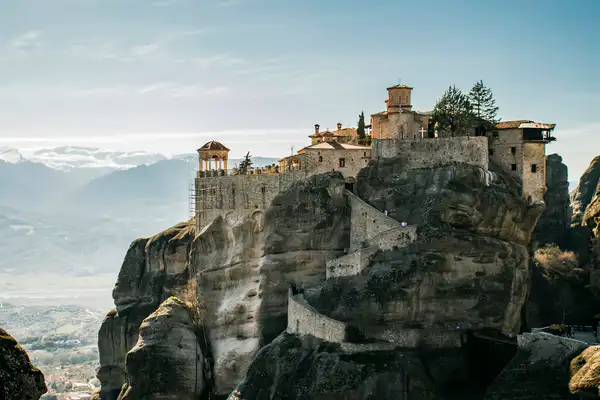
In the early decades of the 14th century, a monk named Athanasios left the ancient monastic republic of Mount Athos, driven away by raids from Catalan and Turkish pirates who had made the Holy Mountain increasingly dangerous. He wandered through mainland Greece with a small band of followers, seeking a place where the spiritual life could be pursued in absolute peace — a place so remote, so inaccessible, that no army could reach it and no worldly temptation could penetrate its walls.
When Athanasios first saw the great stone pillars of Meteora rising from the Thessalian plain, he knew he had found his destination. The locals called the tallest formation Platys Lithos — the Broad Rock — a sheer-sided monolith rising more than 400 meters above the valley floor. No path led to its summit. No ladder could reach it. The local shepherds considered it the domain of eagles and angels, not men.
According to the hagiographic tradition preserved in the Meteora monasteries, Athanasios did not climb the rock by ordinary means. The monks' own chronicles record that he was carried to the summit by an eagle — or, in some versions, by an angel disguised as an eagle. Whether this ascent was miraculous or whether Athanasios found some hidden route up the cliff face that has since been lost to erosion, the result was the same: around 1340, he stood on the summit of the Great Rock, alone in the sky, closer to heaven than any monk in Christendom.
On this unlikely foundation, Athanasios established the Monastery of the Great Meteoron — the "Monastery Suspended in the Air." He brought with him the liturgical traditions and cenobitic rule of Mount Athos, adapting them to the extraordinary conditions of life on a rock summit. He carved a chapel from the living rock, established a garden in the thin soil that had accumulated over millennia, and devised the system of ropes and pulleys that would define Meteorite monasticism for centuries.
The name he chose for himself — "the Meteorite," from the Greek meteoron, "suspended in the air" — became the name for the entire formation. Athanasios imposed strict rules on his growing community: no women were permitted to ascend, monks were to maintain silence for most of the day, and the rope nets used to reach the summit were deliberately not reinforced, so that every ascent was an act of faith in divine providence. He established the typikon — the monastic rule — that governed daily worship, including the cycle of eight prayer services that filled every hour from midnight to evening.
Athanasios died around 1383, having spent more than forty years on the rock summit. By the time of his death, his example had inspired hermits and monks to establish communities on neighboring pillars throughout the Meteora formation. The tradition he founded — of monasticism pursued at the edge of the possible, in deliberate defiance of physical reality — would endure for seven centuries and produce one of the most extraordinary religious communities the world has ever known.