
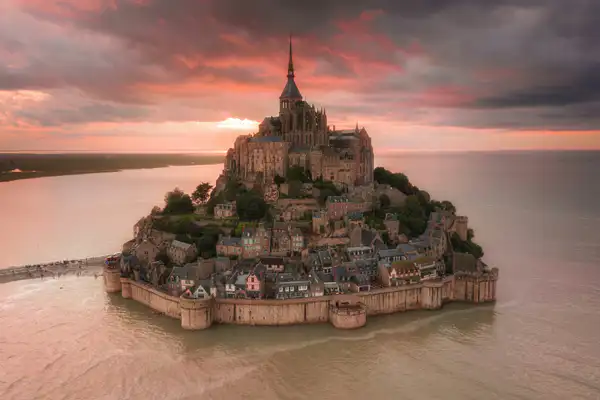
Before any of this happened, the rock had no holy name. People called it Mont Tombe — the Mound of the Dead. Old folk said it marked the passage between this world and whatever waits beyond. The tides in that bay moved, as Victor Hugo would later write, as swiftly as a galloping horse. The sands could swallow a grown man to the waist, and the sea could cut off your retreat before you knew you were trapped. Only hermits lived there, half-starved men fed by a priest from the village of Astériac, who sent bread and supplies on the back of a donkey.
In the year 708, the Archangel Michael chose this forsaken rock for his sanctuary. He was no ordinary angel — Michael was heaven's commander, the warrior who had cast Satan from the sky, and the ancient weigher of human souls. His name itself was a battle cry: Mi-ka-El — Who Is Like God? He came to Bishop Aubert of Avranches in the dead of night. Build me a church upon Mont Tombe. Aubert woke gasping. He was a careful, educated man from a noble family. He told no one. Perhaps, he reasoned, it was only a dream.
The second night, Michael returned, fiercer than before. Aubert lay awake until dawn, wrestling with doubt. The rock was savage — barely attached to the mainland, choked with brambles, crawling with wild beasts. And how could he be certain this wasn't the Devil wearing an angel's face? Scripture itself warned against trusting every spirit. So the bishop crossed himself, prayed for guidance, and once again did nothing. It was a reasonable decision. It was also, as it turned out, a terrible mistake.
On the third night, heaven stopped asking. Michael appeared in a blaze that was not light and not fire but something older than both. He reached out one burning finger and pressed it into the crown of Aubert's skull. The bone gave way. When dawn came, blood ran down the bishop's face and a perfectly round hole gaped in his cranium — a wound that would never heal and never kill him. There was nothing left to debate. Heaven does not ask three times. It tells you twice and then it shows you.
Aubert moved with the urgency of a man who had felt the hand of God. He rallied the people of Avranches to clear the wild rock. Then he sent two of his most trusted men on a journey that would take six months — south across the mountains to Monte Gargano in Italy, where Michael had first appeared two centuries earlier in a sacred cave. They returned carrying relics no money could buy: a fragment of the red hooded cape Michael himself had placed upon his altar, and a piece of marble still bearing the imprint of the archangel's foot.
As the sanctuary rose stone by stone, one final problem remained — there was no fresh water anywhere on the barren rock. Without it, no one could live there to tend the shrine. Then the archangel granted one last miracle: he showed Aubert exactly where to strike the granite, and fresh water burst from the living stone. On the day of consecration — the sixteenth of October, 709 — a woman blind from birth was brought before the new altar. She opened her eyes and saw. Mont Tombe was dead. Mont Saint-Michel, at the peril of the sea, was born.
Three centuries later, monks renovating the abbey found a skeleton sealed in a stone box. They pried open the skull and saw it — a clean, round hole, large enough to slip a human thumb through. Miracles began immediately. Pilgrims came by the thousands. Then came the Revolution, and in 1792, mobs moved to destroy every relic in France. A doctor named Louis-Julien Guérin snatched the skull, claiming he needed it for research. He hid it until the madness passed. Today it sits in a glass reliquary in Avranches. Scientists call the hole trepanation. The faithful call it proof. The mountain still stands.