
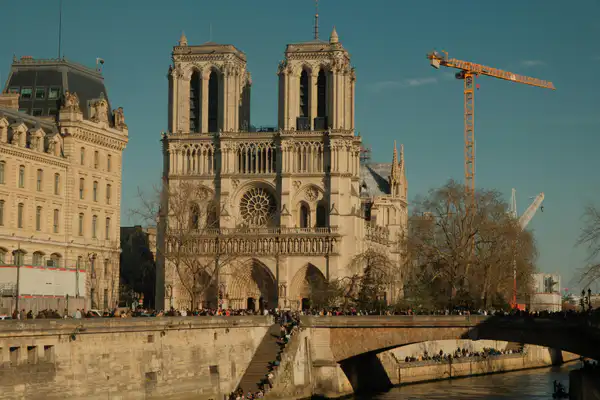
For centuries, a strange rumor has circulated among occultists, hermetic scholars, and seekers of hidden knowledge: Notre-Dame de Paris is not merely a church. It is a vast alchemical textbook, its secrets encoded in stone for those who know how to read them.
This idea reached its peak in 1926 with the publication of "The Mystery of the Cathedrals" by an author known only as Fulcanelli — a pseudonym that no one has ever unmasked. His claim was extraordinary: the medieval master builders who designed the Gothic cathedrals were not simply architects. They were initiates of the hermetic arts, and they encoded their knowledge of alchemy, astrology, and the philosopher's stone into the sculptural programs of their buildings.
According to Fulcanelli, the facade of Notre-Dame contains a complete guide to the Great Work — the alchemical process of transmuting lead into gold, or more mystically, of transforming the base human soul into spiritual gold. The central portal's sculptures depict the stages: nigredo (blackening, death), albedo (whitening, purification), citrinitas (yellowing, awakening), and rubedo (reddening, completion).
The rose windows encode astrological maps. Even the proportions of the nave follow hermetic number theory. Is any of this true? Mainstream historians dismiss Fulcanelli's readings as imaginative projection. But certain facts are hard to wave away. The medieval mason guilds did jealously guard their secrets.
The word "Gothic" itself may derive from "argotique" — the language of argot, or coded speech. And Notre-Dame's sculptures contain imagery that conventional Christian iconography has never satisfactorily explained: figures holding crucibles, serpents swallowing their own tails — the ouroboros — and symbols that appear in no biblical narrative.
Fulcanelli himself remains a mystery as deep as his subject. He is said to have achieved the transmutation — and then vanished. His student, Eugène Canseliet, claimed to have seen him in 1954, looking decades younger than he should have been. The philosopher's stone grants immortality, after all.
They say the best hiding place is in plain sight. Perhaps Fulcanelli still walks among us, smiling at the tourists who photograph Notre-Dame's facade without ever seeing the secrets carved into its stone.