
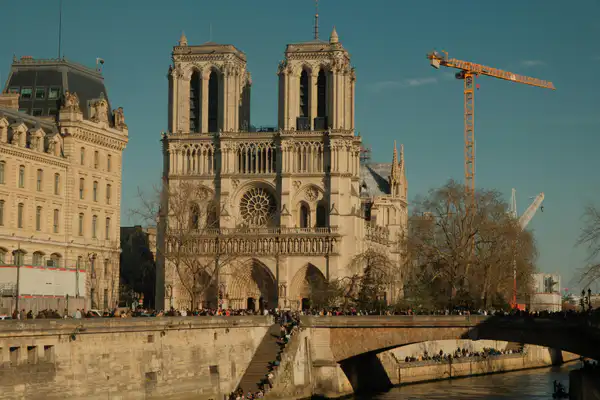
The great iron doors of Notre-Dame's central portal are works of extraordinary craftsmanship — intricately decorated with geometric patterns, floral scrollwork, and iron hinges of such delicate complexity that medieval Parisians were convinced no human hand could have made them.
According to legend, a young locksmith named Biscornet was commissioned to create the ironwork for Notre-Dame's doors in the 13th century. The task was considered impossible — the designs were too complex, the metalwork too fine for any known technique. Biscornet, desperate and terrified of failure, prayed not to God but to the Devil for help.
Satan appeared and struck a bargain: he would forge the doors if Biscornet gave him his soul. Through the night, the sounds of hammering and hellfire echoed from Biscornet's workshop. By morning, the doors were complete — masterpieces of ironwork that seemed almost alive, the metal twisted into patterns that resembled thorns, serpents, and things that should not exist in a house of God.
They say there's no such thing as a free lunch. Biscornet got his lunch — and the bill was his soul. When the doors were installed and the time came to bless them, something extraordinary happened. The doors refused to open. No key, no force, no locksmith's skill could budge them. They would only open when sprinkled with holy water — as if the sacred liquid dissolved whatever demonic lock held them shut.
As for Biscornet, he was found dead in his workshop, his face frozen in an expression of absolute terror. Some say the Devil came to collect his soul. Others say that touching holy water while installing the doors — even accidentally — destroyed him, because a man who has sold his soul to the Devil cannot bear the touch of the sacred.
The ironwork on Notre-Dame's doors survives to this day, though badly damaged during the French Revolution of 1789 when revolutionaries tried to tear them down. Look closely at the left door of the central portal: the patterns seem to shift and writhe if you stare too long. And one last detail that has never been satisfactorily explained — Biscornet means "two-horned" in old French.