
In the 1930s, Joseph Stalin was remaking Moscow from scratch. Old churches? Dynamited. Monasteries? Flattened. The Cathedral of Christ the Savior — the largest Orthodox cathedral in the world — was blown up to make room for a “Palace of Soviets,” a massive government tower that never actually got built. The crater sat empty for decades until they finally just turned it into a swimming pool. That was the mood in Moscow: erase the past, start over.
The man in charge of the wrecking was Lazar Kaganovich, one of Stalin’s inner circle and the most feared city planner in Soviet history. His job was to modernize Moscow — and his version of modern meant wide boulevards, giant parade grounds, and zero religion. One day, Kaganovich walked into Stalin’s office carrying a detailed scale model of the new Red Square.
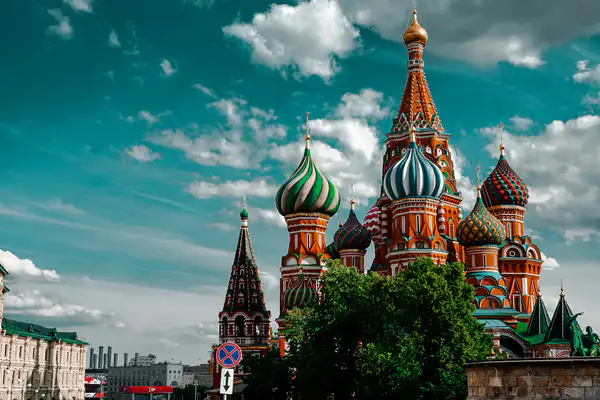
He set it down. It was massive, clean, perfectly Soviet — designed so tanks could roll through and troops could march. But something was missing. Saint Basil’s Cathedral — that wild, candy-colored church at the end of Red Square, the one you’ve definitely seen in photos — was gone. Kaganovich had quietly removed it from the model. He was proposing its demolition.
Here’s the moment everyone remembers. Kaganovich casually lifted the little cathedral off the display — like it was nothing. And Stalin stopped him cold. “Лазарь, поставь на место.” Lazar, put it back.
There’s a second version of how the cathedral was saved. An architect named Pyotr Baranovsky — a man who’d spent his whole career protecting Russian landmarks — was ordered to prepare Saint Basil’s for demolition. He refused. He reportedly sent Stalin a telegram saying he’d rather die than destroy it. They threw him in a labor camp for five years. But they never touched the cathedral.
Both stories might be true — they don’t contradict each other. What we know for certain is this: during a decade when Moscow lost dozens of irreplaceable buildings, when entire neighborhoods vanished overnight, Saint Basil’s somehow survived. It shouldn’t have. Everything around it said it wouldn’t.
Nobody knows exactly why Stalin spared it. Maybe he realized that blowing up Russia’s most recognizable building would be a PR disaster, even for him. Maybe he actually thought it was beautiful. Or maybe — and this is the version that sticks with people — he understood something most dictators miss: you can control a country, but you can’t erase its soul.
Today, Saint Basil’s still stands at the edge of Red Square, exactly where it’s been since 1561. It outlasted Napoleon’s army, the Soviet wrecking ball, and a dictator who destroyed millions of lives without blinking — but couldn’t bring himself to destroy this one building. Some things are bigger than power.