
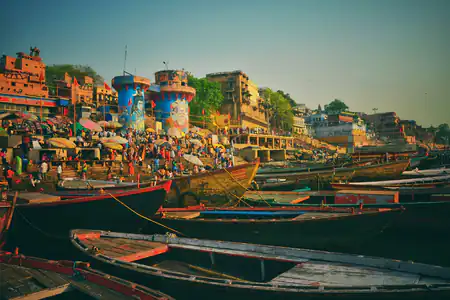
There's a city in India that Hindus believe will outlast the universe. According to ancient scripture, when the cosmos finally ends — every star burned out, every ocean gone — the god Shiva lifts the city of Varanasi off the earth on his trident and holds it above the flood. Everything else disappears. This one city floats on a god's weapon, waiting for creation to begin again. It wasn't born when the universe was born. It won't die when the universe dies. It is the one place that is always.
The story goes like this. Shiva and his wife Parvati — the most powerful couple in Hindu belief — searched the entire cosmos for a place to call home. Heaven was too easy. The underworld was too dark. Every earthly city had some flaw. Then they reached a spot on the Ganges where the river curves north, as if flowing back toward the sky. Shiva said, "This place is as dear to me as my own heart." He called it "the never forsaken" and swore he'd never leave — not even at the end of time.
But the wildest part of this story isn't about Shiva arriving. It's about the time he couldn't get back in. At some point, Varanasi fell into decline, and Shiva left in disgust. While he was gone, a human king named Divodasa took over — and he ruled so perfectly that paradise basically showed up on earth. No disease, no crime, no hunger. His people were so content they stopped praying. Why bother? They had everything. The gods, suddenly, had nothing to do. A mortal had made them irrelevant.
Shiva wanted his city back. So he sent the other gods to find something wrong with Divodasa's kingdom. The sun god came in twelve forms, found nothing wrong, and loved the city so much he stayed. The elephant-headed god Ganesha came in fifty-six forms as spies, set up at every crossroad and gate, found nothing to report, and stayed too. The goddess of wealth found no poverty. The goddess of learning found the culture already perfect. Every spy Shiva sent fell in love with the city instead.
Finally, Vishnu — the god of preservation and maybe the sharpest mind in Hindu mythology — went himself. He didn't look for flaws. He went straight to the deeper truth. He told Divodasa: no matter how perfect your kingdom, your people still age, still suffer, still die, still get reborn. A perfect kingdom gives you everything except the one thing that matters most — freedom from death and rebirth itself. Only Shiva could offer that. Divodasa, wise enough to understand, gave up his throne.
Shiva came home. And the city was richer than before — packed with all the temples the divine spies had built while failing their mission. At the riverfront steps called Dashashwamedh Ghat, Brahma — the god of creation — celebrated Shiva's return. Priests still perform a fire ceremony at that same spot every evening. And at the center of it all stands the Kashi Vishwanath — the "Lord of the Universe" temple — marking the spot where Shiva revealed himself as an endless column of light.
That temple has been torn down and rebuilt multiple times. The most devastating was in 1669, when the Mughal emperor Aurangzeb — who ruled most of India — demolished it and built a mosque on top of the ruins. The original carved wall is still visible inside the mosque today. But the temple came back. The one standing now went up in 1780 and was crowned with gold in 1835. That's the whole point of a city on a god's trident — you can tear it down, but you can't make it stay down.