
Around 2670 BC, in the Nile Valley, a child was born with no claim to greatness whatsoever. His father was a stonemason — a craftsman, not a nobleman. And yet this child — Imhotep — would become Pharaoh Djoser's vizier, his chief architect, the high priest of the sun god Ra at Heliopolis, and the royal physician. All at the same time. No other commoner in the entire history of ancient Egypt ever held so many titles at once.
But his greatest achievement was an idea that changed the course of human civilization. Until then, pharaohs were buried in mastabas — flat-topped rectangular tombs made of mudbrick, impressive but far from eternal. Imhotep looked at those graves and asked a question nobody had dared to ask: what if we build upward, using carved limestone? The result was the Step Pyramid of Saqqara — six tiers of limestone blocks rising 62 meters into the sky. The first monumental stone building in the history of the world.
The technical challenges were staggering. No one had ever quarried, transported, or stacked stone on this scale. Imhotep had to invent everything on the fly: techniques for cutting uniform blocks, methods for hoisting tons of rock to ever-greater heights, engineering solutions to keep a 62-meter tower from collapsing under its own weight. Archaeological digs show the design evolved during construction — he started with a simple mastaba, expanded it, then stacked tiers on top. He was learning as he built.
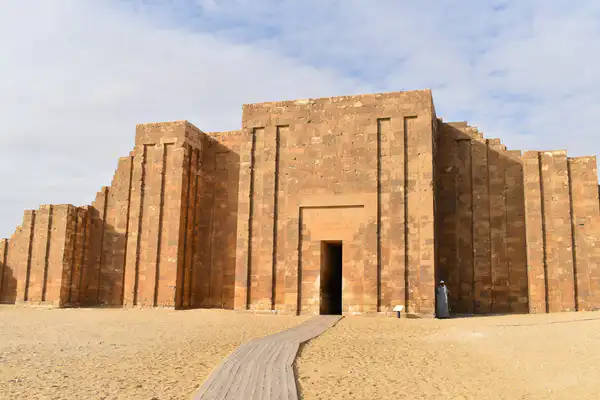
The final result wasn't just a pyramid. It was a complete funerary complex spanning 15 hectares, enclosed by a wall of white limestone with fourteen false doors and a single true entrance. Ceremonial courtyards, temples, chapels — an entire city dedicated to one pharaoh's eternal rest, born from one man's mind.
But Imhotep's genius reached far beyond architecture. Ancient texts credit him with medical writings that were studied for thousands of years after his death. The Edwin Smith Papyrus — a surgical manual dating to around 1600 BC, believed to be based on texts from Imhotep's era — describes 48 injury cases with a rational, evidence-based approach. While others turned to spells and incantations, Imhotep observed, diagnosed, and treated. That level of medical rigor wouldn't return until Hippocrates, over two thousand years later.
They say the third time's the charm — and Imhotep's fate proved it in the most spectacular way imaginable. First, he was honored as a wise mortal. Then, as a legendary sage. And the third time? The people made him a god. By Egypt's Late Period, more than two thousand years after his death, Imhotep was worshipped as the god of medicine and wisdom. The Greeks identified him with Asclepius, their own god of healing, and his cult spread across the entire Mediterranean world.
He remains the only Egyptian without royal blood who was ever made a god. Not through conquest or wealth, but through the transformative power of knowledge. A stonemason's son who raised the first mountain of rock in human history — and who, thousands of years later, still reminds us: true greatness isn't inherited. It's built.