
In 1870, the Schwarzenberg family, who had acquired the former monastery properties at Sedlec, faced a practical problem. The ossuary beneath the Cemetery Church of All Saints was a disordered mess. The half-blind monk's pyramids had partially collapsed over the centuries. Bones spilled across the floor. Visitors, drawn by the macabre reputation of the place, complained of the chaos. Something had to be done.
The Schwarzenbergs hired Frantisek Rint, a local woodcarver from Ceska Skalice. Rint was not famous. He was not an artist in the conventional sense. He was a craftsman who carved furniture, altar pieces, and decorative objects for churches and noble households. Nothing in his previous career suggested what he was about to create.
Rint descended into the ossuary and surveyed the material. Tens of thousands of bones, bleached by centuries, fragile but structurally sound. They were not wood, but they could be worked with a woodcarver's eye for form and balance. Rint began to envision the bones not as remains but as raw material, each piece with a specific shape, weight, and aesthetic potential.
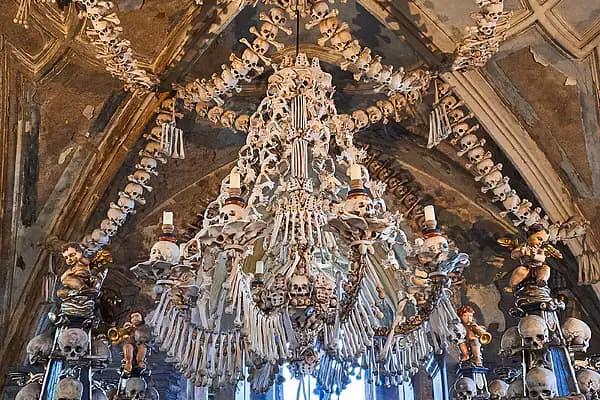
He started with the chandelier. Suspended from the center of the vaulted ceiling, it would be the ossuary's focal point. Rint used at least one of every bone in the human body: skulls at the corners, femurs forming the arms, vertebrae strung like beads, pelvises and scapulae creating the lampshade-like canopy. The completed chandelier is both magnificent and horrifying, a piece of decorative art that forces the viewer to recognize that every component was once part of a living person.
Next came the garlands. Strings of skulls, draped between pillars and along the vaulted ceiling like macabre bunting, gave the space a festive quality that makes visitors deeply uncomfortable. The Schwarzenberg coat of arms, requested by the family, was rendered in bone with extraordinary detail, including a raven pecking at the eye of a defeated Turk, a reference to a Schwarzenberg military victory.
Rint worked with four great bell-shaped mounds of bones in the corners, with chalice-shaped arrangements, with crosses and monstrances. He treated human remains with the same technical precision he would have applied to oak or linden, measuring, fitting, securing each piece in its place.
When he finished, Rint did something that has haunted visitors ever since. He signed his work. On the wall near the entrance, spelled out in bones, is his name: F. RINT. It is a signature that transforms the ossuary from an anonymous curiosity into a work of authorship. Rint claimed it. He stood behind it. This was his art.
The signature raises the question that every visitor must confront: is this art? Is it reverent? Is it desecration? Rint left no written explanation of his intentions. His signature says only: I made this. What "this" means is left for each visitor to decide, standing beneath a chandelier of the dead, surrounded by the arranged remains of forty thousand souls who never imagined that their bones would become someone's medium, someone's material, someone's masterpiece.