
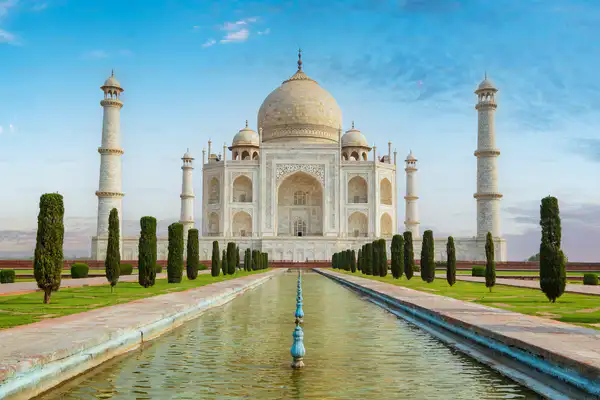
In 1665, a French gem dealer named Jean-Baptiste Tavernier stood by the Yamuna River in Agra — and heard a story that would haunt the world for centuries. He’d crossed the globe six times chasing diamonds and talked his way into the Mughal court. Guides told him something wild: Emperor Shah Jahan hadn’t just built the white marble Taj Mahal for his dead wife. He’d planned a second one — identical, but entirely of black marble — as his own tomb, across the river.
Tavernier published this in his 1676 memoir, but here’s the thing — he never mentioned black marble. He wrote one line: Shah Jahan started building his own tomb across the river, but a war between his sons stopped him. That’s it. Over three centuries, writers added details — the black stone, the mirror design, a silver bridge connecting the two tombs. The legend got so beautiful that everyone just assumed it was true.
Then in 1871, British archaeologist A.C.L. Carlleyle seemed to prove it. He was digging in a ruined garden called Mehtab Bagh — the “Moonlight Garden” — directly across from the Taj. Under centuries of mud, he found blackened stones and foundations shaped like the base of something enormous. He declared he’d found the Black Taj. For a century, nobody challenged him. Tourists crossed the river to stand on what they believed were ruins of Shah Jahan’s dream.
In the 1990s, archaeologists finally tested the legend. India’s Archaeological Survey spent six years excavating the site, removing ninety thousand cubic meters of earth. What they found killed the myth. Those “black stones”? White marble — the same stone as the Taj, darkened by centuries of flooding and moss. Lab tests confirmed it. The foundations were garden pavilions around a pool. No quarry waste, no debris. Nothing you’d expect from a monument that size.
The historical record backs this up. Shah Jahan’s court historians recorded every project obsessively — materials, wages, labor, transport. Their chronicle, the Padshahnama, says nothing about a second tomb. Not one word. The timeline makes it nearly impossible: the Taj wasn’t finished until around 1653, Shah Jahan fell ill in 1657, and his son Aurangzeb overthrew him right after. That leaves four years — for a monument that took twenty-two to build.
Here’s what they actually found at Mehtab Bagh — and it’s more poetic than any legend. The garden was built by Babur, founder of the Mughal dynasty, and Shah Jahan restored it as a moonlit viewing platform. It had an octagonal pool with twenty-five fountains, ringed by night-blooming flowers. In 2006, researchers filled the pool and waited for dark. The Taj appeared reflected in the still water — a trembling twin made of nothing but moonlight.
So why won’t the legend die? Because we want it to. A love story that ends with a heartbroken emperor staring at a white tomb from his prison tower feels incomplete. The Black Taj completes the narrative — his love was so vast that one monument wasn’t enough, and only his son’s betrayal stopped him. People need that story. It turns the Taj from a monument to loss into a monument to impossible ambition, which hits even harder.
But the truth is better. On moonlit nights, Shah Jahan — even from his prison in Agra Fort — could watch the Yamuna turn the white Taj into its own dark reflection. Something you can’t touch, can’t enter, can’t keep. It appears when the water is still and vanishes the moment it moves. Maybe that’s the truest monument to grief — not permanent, but trembling and alive. The Black Taj was never built because it was never needed. The river built it every night.