
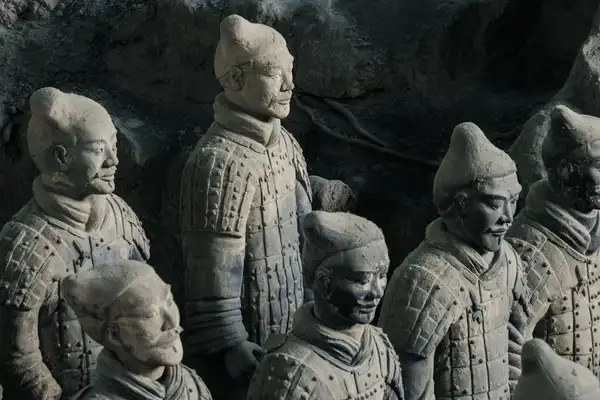
Around 100 BC, a Chinese historian named Sima Qian made a claim that sounded completely insane. He said the tomb of China's first emperor — Qin Shi Huang, the man behind the Great Wall and the Terracotta Army — contained rivers of flowing liquid mercury. Not a metaphor. Actual mercury, pumped through channels to copy the country's real waterways.
Sima Qian described it in the Shiji, China's great historical record. He wrote that mercury was "used to simulate the hundred rivers, the Yangtze, the Yellow River, and the great sea, set to flow mechanically." The ceiling was studded with gems to mimic the night sky. The floor was a scale map of the empire. Stars above, rivers below — a private universe built for one dead man.
For two thousand years, most people assumed he was exaggerating. Mercury rivers? Underground constellations? It sounded like mythology, not history. The tomb was right there the whole time — a 76-meter hill covered in pomegranate trees near the city of Xi'an — but nobody could prove what was inside without cracking it open.
Then in 2003, Chinese scientists tested the soil directly above the tomb for mercury. What they found was staggering: mercury levels over the burial chamber were up to 100 times higher than the surrounding area. And the mercury wasn't spread randomly. It was concentrated along paths that matched the actual positions of China's major rivers on a map.
Sima Qian wasn't exaggerating. He was being literal. Qin Shi Huang had built an entire cosmos underground — mercury rivers tracing his empire's waterways, jeweled constellations overhead, crossbow traps standing guard like phantom armies. Buried under 76 meters of earth, he created an eternal China where the rivers never dried, the stars never set, and the emperor never stopped ruling.
Here's the twist: China still won't open the tomb. Mercury kills bacteria and stops decay, making it an incredible preservative. Whatever is inside has been sealed in mercury vapor for over 2,200 years. Scientists worry that cracking it open could destroy everything in minutes. So the greatest archaeological mystery on Earth just sits there, untouched.
Some researchers believe the tomb holds scrolls and manuscripts that could rewrite what we know about ancient China. Qin Shi Huang standardized Chinese writing itself — why wouldn't he bring books into the afterlife? If they're in there, they've been perfectly sealed in mercury-filled darkness for two millennia. And we can't touch them.
The tomb is still there today, in plain sight. Hundreds of thousands of tourists visit every year. They photograph the famous terracotta warriors, buy souvenirs, and walk right past that quiet green hill without a second thought. Beneath their feet, in the dark, the mercury rivers of China's first emperor may still be flowing.