
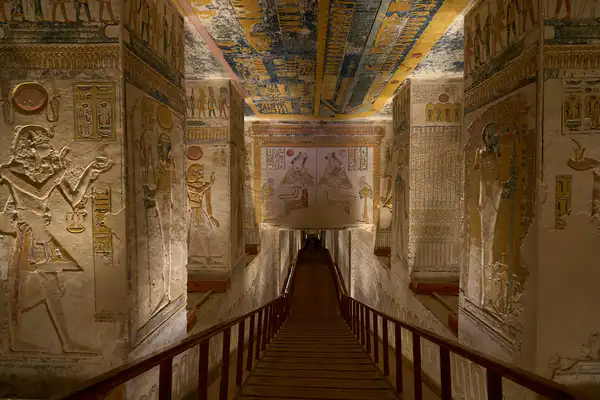
Egypt, around 1110 BC. The pharaohs have been burying their dead in the Valley of the Kings for centuries — filling underground tombs with gold, jewels, and everything a god-king might need in the afterlife. But by the time Ramesses IX sits on the throne, the empire is broke. Crops are failing, workers haven't been paid in months, and right next door to the poorest villages in Thebes sits more gold than most people will ever see. It was only a matter of time.
The scandal started with two mayors who hated each other. Paser, the mayor of east Thebes — the living city — accused Pawera, the mayor of the west bank where the royal tombs were, of letting robbers loot the graves. Maybe even taking a cut. This wasn't just politics. In ancient Egypt, the pharaoh's tomb was sacred on a level we can barely imagine. Robbing a royal burial wasn't just theft — it was an attack on the order of the universe itself.
The government sent officials to inspect the tombs. What they found was devastating. Tomb after tomb, broken into. Coffins smashed. Mummies unwrapped and stripped of every ring, amulet, and piece of gold. Treasures meant to last for eternity — sold at local markets. The investigation ripped through the workers' villages, and the deeper they dug, the worse it got. Stonecutters, priests, guards, even officials whose entire job was protecting these tombs — all in on it.
The trials that followed left behind some of the most jaw-dropping court records in history. Some confessions came willingly. Others were beaten out of people — they'd strike the soles of your feet with sticks until you talked. The most famous confession came from a stonecutter named Amenpnufer, who described breaking into the tomb of Pharaoh Sobekemsaf II with the calm of someone describing their morning routine.
His words, preserved on papyrus for over three thousand years: "We went to rob the tombs as is our usual habit. We found the god lying at the back of his burial place. We collected the gold from the mummy, together with his amulets and jewels. We set fire to their coffins." As our usual habit. Like it was just another day at work. The crew split the gold into eight equal shares — this wasn't some desperate act. It was organized crime, ancient-world style.
The ringleaders were almost certainly executed. But the robberies never stopped. The economy was collapsing, and for the starving workers of western Thebes, royal gold was the only way to survive. Eventually, the priests who guarded the royal dead gave up trying to protect the tombs. Instead, they secretly removed the mummies and hid them in two locations so well concealed that they weren't found for nearly three thousand years.
When those stashes were finally discovered in the 1800s, the bodies of Egypt's most legendary pharaohs — Ramesses the Great, Seti I, Thutmose III — were found stacked together in plain coffins, stripped of all their treasure but still intact. The priests had saved them from total destruction by hiding them from their own people.
Three thousand years ago, a stonecutter looked at the most sacred tombs on Earth and shrugged: that gold's doing nothing for the dead. The Tomb Robbery Papyri are proof that no treasure, no matter how sacred, is safe from people who are hungry enough — and that the line between protector and thief has always been thinner than we'd like to believe.