
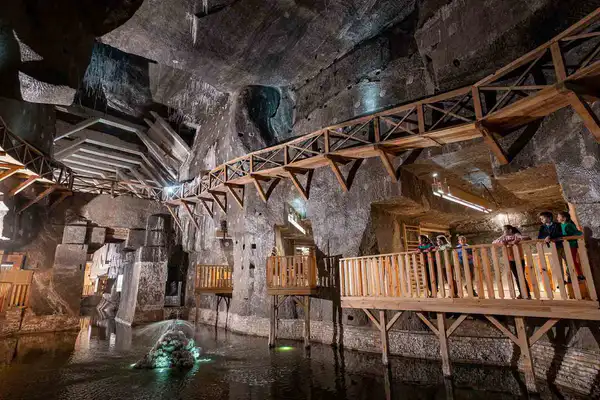
A hundred and one meters below the green fields of southern Poland, in a darkness that has never seen sunlight, someone built a cathedral. Not from stone. Not from marble. From salt. Every surface of the Chapel of St. Kinga — the floor beneath your feet, the walls beside you, the chandeliers over your head — is carved from rock salt deep inside the Wieliczka mine, just outside the city of Krakow. It took sixty-seven years and three generations of miners to finish.
Think about that timeline. A miner named Jozef Markowski first drove his chisel into the salt in 1896 — before the Wright brothers flew at Kitty Hawk, before anyone had heard a radio broadcast. When the last carver set down his tools in 1963, humans had been to space and the Beatles were recording their first album. This chapel spans the entire birth of the modern world, carved by men who went underground every morning and came back up every night, chipping at salt with hand tools.
The space is enormous — fifty-four meters long, eighteen wide, twelve high. Roughly the footprint of a basketball court with a four-story ceiling, all cut from solid salt. Markowski started it. Another miner named Antoni Wyrodek picked up where he left off. Then others followed. None of them lived to see the finished chapel. They just carved their piece and trusted the next generation would keep going.
The chandeliers are what stop people in their tracks. Each one holds between twenty and thirty thousand individual salt crystals, shaped by hand and strung together to catch the light. Salt doesn't glow like glass — it's softer, warmer, almost like candlelight trapped inside stone. Standing underneath, surrounded by this amber glow that seems to pour from the walls themselves, most visitors just go quiet. There's nothing to say. You're underground, staring at something more beautiful than anything on the surface.
The wall carvings are just as stunning. Miners sculpted scenes from the Bible directly into the salt, and the most famous piece is a full-scale version of Leonardo da Vinci's The Last Supper. Jesus and his apostles emerge from the wall with an emotional depth you'd expect from Italian marble, not a mineral people sprinkle on their dinner. The salt's natural crystal texture makes the figures shimmer in the lamplight. It has no right to work as an art material. It absolutely does.
The chapel is still a working church. Couples get married down here — walking a salt-crystal aisle toward a salt-crystal altar, under chandeliers made of the same stuff. Orchestras perform concerts in the chamber, and the sound is remarkable — the curved salt walls shape the acoustics into something warm and rich that no hall on the surface can match. Catholic mass happens regularly, a priest's voice echoing through a room that took longer to carve than most of Europe's great cathedrals.
Here's what stays with you. The men who built this weren't trained sculptors or architects. They were salt miners — guys who spent their lives underground, hands raw, lungs full of mineral dust, doing some of the hardest physical labor in Europe. And in their off-hours, across nearly seven decades, they made something that rivals any cathedral on earth. The greatest masterpiece in Poland might be the one that sits where the sun has never once reached.