
About
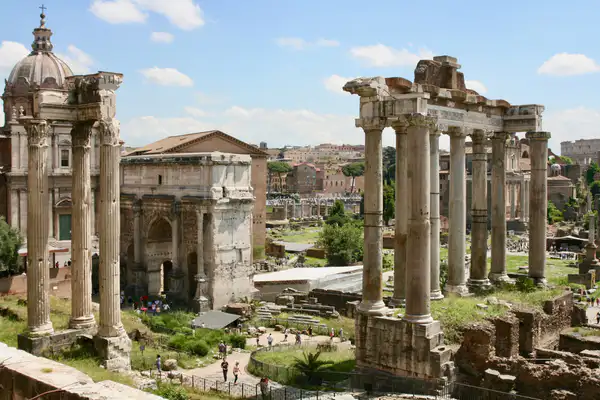
s monumental structures chronicle Rome's evolution from a modest kingdom to the mightiest empire the world had known. The Temple of Saturn, with its eight surviving granite columns, served as the state treasury and hosted the raucous festival of Saturnalia. The circular Temple of Vesta housed the sacred flame tended by the Vestal Virgins, whose extinction was believed to foretell Rome's destruction. The Temple of Castor and Pollux commemorated the divine twins' miraculous appearance at the Battle of Lake Regillus. The Basilica of Maxentius, with its colossal coffered vaults, demonstrated Roman engineering at its most ambitious. The Arch of Titus immortalized the conquest of Jerusalem in 70 AD, its relief panels depicting the plundered menorah carried in triumph — images so charged that observant Jews traditionally refused to walk beneath it. The Palatine Hill, rising 40 meters above the Forum, was Rome's most prestigious address and the origin of the very word "palace" (from the Latin Palatium). According to legend, this was where Romulus traced the sacred boundary of the new city on April 21, 753 BC, and where the she-wolf nursed the twin founders in the Lupercal cave. In historical times, Augustus chose the Palatine for his relatively modest residence, establishing a precedent that subsequent emperors transformed into extravagance. Tiberius, Caligula, Nero, Domitian, and Septimius Severus each expanded the imperial complex until the entire hill became a single vast palace overlooking the Forum, the Circus Maximus, and the city below. Together, the Forum and Palatine Hill form an archaeological landscape of unparalleled richness, inscribed as part of the UNESCO World Heritage Site "Historic Centre of Rome" in 1980. Walking through the ruins, visitors traverse twelve centuries of continuous urban development — from the archaic foundations of the Regia, traditionally the palace of King Numa Pompilius, to the late antique Column of Phocas, the last monument erected in the Forum in 608 AD. The site remains the single most evocative window into the daily life, political ambition, religious devotion, and architectural genius of ancient Rome.
Historical Significance
“The Roman Forum and Palatine Hill together constitute the most important archaeological complex of the ancient Roman world. The Forum was the civic nucleus of a civilization that at its height governed 70 million people across three continents, and its ruins preserve physical evidence of virtually every aspect of Roman public life — politics, religion, justice, commerce, and spectacle. The site's significance extends far beyond archaeology. The Forum established the template for public civic space that influenced every subsequent Western society. The concept of a central forum or square as the heart of urban life, the architectural language of columns, arches, and basilicas, the very idea of monumental public buildings as expressions of shared identity — all originate here. The United States Supreme Court building, the Arc de Triomphe in Paris, and government buildings worldwide are direct architectural descendants of structures first perfected in this valley. The Palatine Hill holds equal historical weight as the legendary birthplace of Rome and the seat of imperial power for five centuries. The word "palace" in English, French, Spanish, Italian, German, and dozens of other languages derives directly from the Latin Palatium — the name of this hill. The imperial residences built here, particularly Domitian's sprawling Domus Augustana, defined the concept of a ruler's residence as a statement of absolute power and divine authority. The site was inscribed as part of the UNESCO World Heritage Site "Historic Centre of Rome, the Properties of the Holy See in that City Enjoying Extraterritorial Rights and San Paolo Fuori le Mura" in 1980, extended in 1990, recognizing the Forum and Palatine as irreplaceable monuments of universal significance.”
داستانها
3History
👑 Built by
Multiple builders across 1,200 years: Roman kings, Republic magistrates, and emperors from Augustus to Phocas
7th century BC - Marshy valley drained by the Cloaca Maxima, Forum established
753 BC (traditional) - Romulus founds Rome on the Palatine Hill
509 BC - Temple of Saturn constructed, one of the Forum's oldest temples
484 BC - Temple of Castor and Pollux dedicated after the Battle of Lake Regillus
362 BC - Marcus Curtius leaps into the chasm in the Forum (legendary)
44 BC - Julius Caesar cremated in the Forum; Temple of Divus Iulius later built on the spot
29 BC - Arch of Augustus erected to commemorate victory at Actium
2 BC - Augustus completes the Forum of Augustus adjacent to the old Forum
64 AD - Great Fire of Rome destroys portions of the Forum and Palatine
81 AD - Arch of Titus erected to celebrate the conquest of Jerusalem
92 AD - Domitian completes the Domus Augustana, the definitive imperial palace on the Palatine
203 AD - Arch of Septimius Severus erected in the Forum
312 AD - Basilica of Maxentius completed by Constantine
394 AD - Emperor Theodosius I disbands the Vestal Virgins, ending over 1,000 years of tradition
608 AD - Column of Phocas erected, the last monument added to the Forum
1803 - Systematic archaeological excavations begin under Carlo Fea
1980 - Inscribed as UNESCO World Heritage Site as part of the Historic Centre of Rome