
About
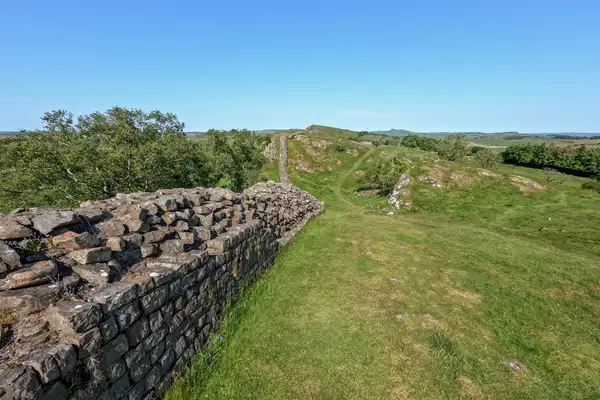
Hadrian's Wall is the most important monument built by the Romans in Britain, a colossal frontier fortification stretching 73 miles (117.5 kilometres) from Wallsend-on-Tyne on the east coast to Bowness-on-Solway on the west, cutting across the narrow waist of northern England through some of the most dramatic and desolate landscape in the British Isles. Commissioned by Emperor Hadrian in AD 122, during his famous tour of the empire's provinces, the Wall was conceived not merely as a military barrier but as a monumental statement of Roman imperial power — a line drawn across the earth declaring: here civilization ends, and beyond lies the barbaricum. Construction was carried out primarily by legionary soldiers — skilled engineers and masons drawn from the three legions stationed in Britain: Legio II Augusta, Legio VI Victrix, and Legio XX Valeria Victrix — and the sheer scale of the enterprise ranks it among the most ambitious building projects undertaken anywhere in the ancient world. The Wall as originally planned was to be built entirely of dressed stone, approximately 3 metres (10 Roman feet) wide and up to 4.5 metres high, with a parapet walkway adding a further 2 metres, bringing the total height to roughly 6 metres. Every Roman mile (approximately 1,480 metres) along its length, a small fortified gateway called a milecastle was constructed, housing a garrison of perhaps 20-30 soldiers and controlling passage through the Wall. Between each pair of milecastles, two evenly spaced observation turrets provided elevated lookout positions. This systematic arrangement — wall, turret, turret, milecastle, turret, turret, milecastle — repeated with mechanical precision across the entire width of Britain, producing approximately 80 milecastles and 160 turrets. To the north of the Wall, a broad V-shaped ditch was excavated, and to the south, a massive earthwork known as the Vallum — a flat-bottomed ditch flanked by two parallel mounds — defined the military zone's southern boundary. As construction progressed, the original plan was modified: the western third of the Wall was initially built in turf and timber (later replaced in stone), and the Wall's width was reduced from 3 metres to approximately 2.4 metres to accelerate completion. Sixteen major forts were added directly on or immediately adjacent to the Wall line, each housing between 500 and 1,000 auxiliary soldiers — cavalry and infantry units recruited from across the empire, including Gauls, Batavians, Dacians, Syrians, and North Africans. The total garrison of the Wall and its associated installations may have exceeded 9,000 men at its peak. For nearly three centuries, Hadrian's Wall functioned as the northern frontier of the Roman Empire in Britain — a living, breathing military community stretching across the landscape. It was not a static defensive line in the modern sense but a permeable frontier: a controlled zone where trade, taxation, immigration, and diplomacy were managed alongside military defence. The gates in the milecastles and forts regulated the movement of people and goods between the Roman province of Britannia to the south and the unconquered tribal territories of Caledonia to the north. Civilian settlements — vici — grew up around the major forts, populated by merchants, craftsmen, families of soldiers, and local Britons drawn to the economic opportunities of the frontier. The Wall was briefly abandoned in the AD 140s when Emperor Antoninus Pius pushed the frontier north to the Antonine Wall in central Scotland, but this advance proved unsustainable, and Hadrian's Wall was recommissioned as the primary frontier within a generation. The Wall endured as an active military installation until the end of Roman rule in Britain around AD 410, after which it was gradually abandoned, quarried for building stone, and absorbed into the pastoral landscape of northern England. Today, substantial sections of the Wall survive — most spectacularly along the volcanic escarpment of the Whin Sill in Northumberland, where the Wall rides the dramatic crests and dips of the terrain like a stone serpent — and the site was inscribed as a UNESCO World Heritage Site in 1987 as part of the transnational "Frontiers of the Roman Empire" designation. It remains one of the most visited and most evocative archaeological monuments in Europe, a place where the ambitions, fears, and daily lives of Roman soldiers stationed at the edge of the known world are written into every stone.
Historical Significance
“Hadrian's Wall is the most significant surviving monument of Roman Britain and one of the most important Roman military structures anywhere in the former empire. Its significance extends far beyond its physical dimensions: the Wall is the most complete and best-studied example of a Roman frontier system, providing unparalleled insight into how Rome controlled, administered, and conceptualized the boundaries of its vast dominions. Unlike many Roman frontiers that followed natural barriers — the Rhine, the Danube, the Sahara — Hadrian's Wall was an entirely artificial creation imposed upon the landscape through sheer engineering will, a 73-mile statement that the limits of the civilized world were wherever Rome said they were. Militarily, the Wall represents the culmination of Roman frontier defence doctrine. Its integrated system of wall, ditch, vallum, milecastles, turrets, and forts created a layered defensive zone unlike anything seen before in the ancient world. The Wall did not simply block movement; it channelled, controlled, and monitored it. Every traveller, every herd of cattle, every cartload of goods crossing between the Roman province and the tribal north had to pass through a controlled gateway, where they could be inspected, taxed, and recorded. This was not just a military installation — it was the physical embodiment of Roman bureaucratic control, a border in the modern sense, centuries before the concept existed elsewhere in Europe. The intelligence gathered at the Wall — who was moving, where they were going, what they were carrying — was as valuable as any military victory. Culturally and historically, the Wall offers an extraordinary window into the diversity of the Roman Empire. The auxiliary units stationed along its length were recruited from provinces spanning from Spain to Syria, from the Danube frontier to North Africa. Inscriptions, altars, and archaeological finds reveal a remarkable cultural mosaic: Syrian archers worshipping their native gods at Carvoran, Batavian cavalry swimming the North Tyne in full armour as a training exercise (recorded on a tombstone at Chesters), and Hamian archers from modern-day Syria garrisoned at Bar Hill. The Vindolanda writing tablets, discovered in the waterlogged remains of a pre-Hadrianic fort, have transformed our understanding of daily life on the frontier, revealing the human side of imperial power — birthday invitations, requests for warm clothing, complaints about the local beer, and heartfelt letters between friends separated by thousands of miles. Hadrian's Wall is not merely a monument to Roman power; it is a monument to the lives of the thousands of ordinary people — soldiers, families, merchants, slaves, and local Britons — who lived, worked, loved, and died along the edge of the known world.”
物語
2History
👑 Built by
Emperor Hadrian (ordered AD 122)
AD 122 - Emperor Hadrian visits Britain and orders the construction of a continuous frontier wall from coast to coast
AD 122-128 - Primary construction phase: legionary soldiers build the stone wall, milecastles, turrets, and ditch system across 73 miles
AD 124-130 - Sixteen major forts added to the Wall line, replacing an earlier plan to garrison troops behind the Wall in existing forts
AD 130-133 - The Vallum earthwork is constructed to the south of the Wall, defining the military exclusion zone
AD 138 - Emperor Hadrian dies; his successor Antoninus Pius orders an advance into Scotland
AD 142 - The Antonine Wall is constructed across central Scotland; Hadrian's Wall is partially decommissioned
AD 160s - The Antonine Wall is abandoned after persistent tribal attacks; Hadrian's Wall is recommissioned as the primary frontier
AD 180 - Tribes from north of the Wall breach the frontier and overrun part of the garrison, killing a Roman general (Cassius Dio, Roman History)
AD 197 - Governor Clodius Albinus strips the Wall garrison to support his bid for the imperial throne; northern tribes exploit the weakness
AD 208-211 - Emperor Septimius Severus campaigns in Scotland with a massive army; the Wall is extensively repaired and rebuilt upon his orders
AD 296 - Emperor Constantius Chlorus restores the Wall after damage inflicted during the revolt of Carausius and Allectus
AD 367 - The "Great Barbarian Conspiracy": Picts, Scots, Attacotti, and Saxon raiders simultaneously attack Britain from all directions; the Wall frontier collapses
AD 369 - Count Theodosius restores order and repairs the Wall installations for the last time
AD 383 - Magnus Maximus withdraws troops from Britain to support his claim to the Western Empire; the Wall garrison is permanently weakened
AD 410 - Emperor Honorius tells British cities to look to their own defence; Roman administration in Britain effectively ends, and the Wall is gradually abandoned
7th-8th century - The Venerable Bede describes the Wall in his "Ecclesiastical History of the English People," attributing it to Emperor Septimius Severus
1600 - William Camden publishes the first modern survey of the Wall in "Britannia," correctly attributing it to Hadrian
1801-1820 - John Clayton begins purchasing farms along the Wall to preserve the remains from stone robbing
1987 - Hadrian's Wall inscribed as a UNESCO World Heritage Site as part of the "Frontiers of the Roman Empire"
2003 - The Hadrian's Wall Path National Trail opens, running 84 miles from coast to coast along the Wall line