
About
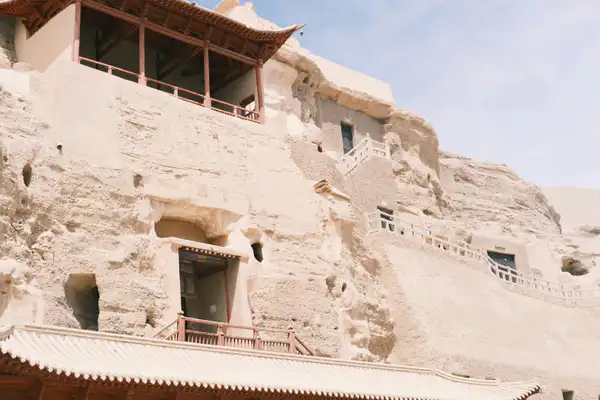
The Mogao Caves are the world's greatest treasury of Buddhist art — 735 caves carved into a mile-long cliff face in the Gobi Desert, containing 2,415 painted clay sculptures and 45,000 square meters of murals spanning a thousand years of continuous artistic creation. Known as the "Caves of the Thousand Buddhas," they represent the most comprehensive collection of Buddhist art on Earth. Located at the eastern edge of the Taklamakan Desert near the oasis town of Dunhuang, the caves sit at one of the most strategic points on the ancient Silk Road — where the northern and southern routes around the desert converged before entering China proper. For a millennium, every merchant, pilgrim, monk, soldier, and diplomat traveling between China and the West passed through Dunhuang, and many left their mark in the caves. The first cave was carved in 366 AD by the monk Yuezun, who saw a vision of a thousand Buddhas radiating golden light from the cliff face. Over the next thousand years, successive dynasties — Northern Wei, Sui, Tang, Five Dynasties, Song, Western Xia, and Yuan — added more caves, more sculptures, more murals, each generation layering its art upon the work of those before. The caves were largely abandoned after the Yuan Dynasty and slowly buried by desert sand. They were rediscovered in 1900 by a Taoist monk named Wang Yuanlu, who stumbled upon a sealed chamber containing approximately 50,000 manuscripts, paintings, and textiles — the "Library Cave" — one of the most significant documentary discoveries in history. UNESCO inscribed the Mogao Caves in 1987. They are considered one of the most important sites for the study of Buddhist art, Silk Road history, and Chinese civilization.
Historical Significance
“The Mogao Caves are the visual encyclopedia of the Silk Road. Within their painted walls, one can trace the evolution of Buddhist art from the Indian-influenced styles of the Northern Wei through the cosmopolitan magnificence of the Tang Dynasty to the Tibetan-influenced paintings of the Western Xia and Yuan periods. But the caves contain far more than Buddhist art. Their murals depict daily life on the Silk Road in extraordinary detail: merchants loading camels, musicians playing instruments from Persia, India, and Central Asia, fashion from a dozen cultures, agricultural practices, wedding ceremonies, funerary rituals, and military campaigns. They are a time capsule of medieval globalization. The Library Cave (Cave 17), sealed around 1002 AD and not reopened until 1900, contained manuscripts in Chinese, Tibetan, Sanskrit, Sogdian, Turkic, Khotanese, and Hebrew — proving that Dunhuang was one of the most linguistically diverse places on Earth. The documents include the world's oldest printed book (the Diamond Sutra, dated 868 AD), Buddhist scriptures, Confucian texts, Taoist writings, financial records, contracts, letters, music scores, star charts, and even a guide to dream interpretation. The caves' significance extends to art conservation science. The Dunhuang Academy, established in 1944, pioneered techniques for preserving murals in desert conditions that are now used worldwide. Their digital imaging project, creating pixel-perfect records of every cave, is one of the most ambitious cultural preservation efforts in history.”
Récits
2History
👑 Built by
Monk Yuezun (first cave, 366 AD); successive generations of monks, merchants, and imperial patrons over 1,000 years
366 AD - Monk Yuezun carves the first cave after seeing a vision of a thousand golden Buddhas
420-589 AD - Northern Dynasties period: rapid expansion of cave construction
581-618 AD - Sui Dynasty: over 100 new caves added
618-907 AD - Tang Dynasty golden age: the most magnificent caves created, including the giant Buddha in Cave 96
781-848 AD - Tibetan Empire controls Dunhuang; Tibetan Buddhist art added to the caves
~1002 AD - Library Cave (Cave 17) sealed — 50,000 manuscripts and artifacts entombed
1036-1227 AD - Western Xia and Mongol periods: new caves added in Tangut and Tibetan styles
~14th century - Cave construction ceases; site gradually abandoned as Silk Road trade declines
1900 - Taoist monk Wang Yuanlu discovers the sealed Library Cave
1907 - Aurel Stein arrives and acquires thousands of manuscripts for the British Museum
1908 - Paul Pelliot examines and selects manuscripts for the Bibliothèque nationale de France
1924 - American explorers Langdon Warner removes murals and sculptures (now at Harvard)
1944 - Dunhuang Academy established to protect and study the caves
1987 - Inscribed as UNESCO World Heritage Site
2016 - "Digital Dunhuang" project launches, making cave interiors available online worldwide