
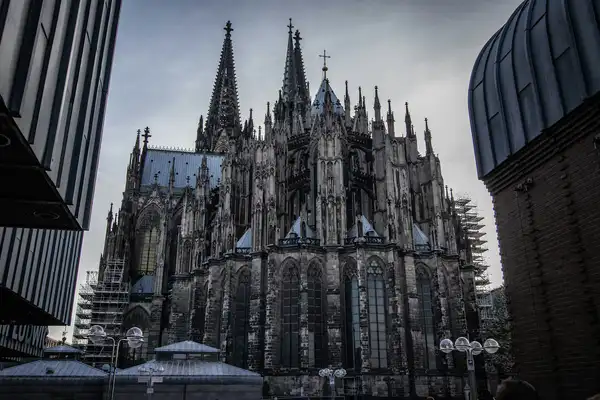
About
Cologne Cathedral is the supreme achievement of Gothic architecture north of the Alps — a building so ambitious in conception that it took 632 years to complete, spanning from the age of Crusades to the age of Bismarck. Its twin spires, rising 157 meters above the Rhine, made it the tallest structure in the world from its completion in 1880 until the Eiffel Tower surpassed it in 1889. Even today, the Dom dominates the Cologne skyline with an authority that no modern skyscraper has been able to diminish, its blackened limestone silhouette visible from every approach to the city — a Gothic mountain of stone that has survived fire, neglect, Napoleon, and 262 Allied bombing raids. The cathedral was begun in 1248 under Archbishop Konrad von Hochstaden to house what was then the most precious relic in northern Europe: the Shrine of the Three Magi, the golden reliquary said to contain the bones of the Three Wise Men who brought gifts to the infant Jesus. This single relic transformed Cologne from a prosperous trading city into the greatest pilgrimage destination in the Holy Roman Empire, rivaling Rome, Jerusalem, and Santiago de Compostela. The cathedral needed to be worthy of its treasure, and the architects — beginning with Master Gerhard — designed a building of staggering proportions: a five-aisled nave 144 meters long, a choir 45 meters high, and a pair of towers that, when finally completed, would be the tallest in Christendom. But ambition outran resources. By 1473, after two and a half centuries of construction, work ground to a halt. The south tower stood at only 59 meters — less than half its planned height. A massive crane perched on the stump of the unfinished tower became one of the defining features of the Cologne skyline for four hundred years, a rusting monument to medieval overreach. The nave was walled off with a temporary partition. The cathedral stood half-built, half-ruined, a Gothic torso waiting for a body. The completion came only in the 19th century, driven by a wave of Romantic nationalism. King Frederick William IV of Prussia championed the project as a symbol of German unity, and the Central-Dombauverein (Central Cathedral Building Association) raised funds across the German states. Using the original medieval plans, which had been miraculously rediscovered in 1814 and 1816, architects completed the towers, the transept, and the nave in faithful Gothic style. On August 14, 1880, the cathedral was finally consecrated in the presence of Kaiser Wilhelm I — a celebration that was as much about the newly unified German Empire as about God. The 632-year construction gap makes Cologne Cathedral one of the longest building projects in human history, and the result — a seamless fusion of medieval ambition and 19th-century engineering — is one of the most visited landmarks in Europe, drawing six million visitors each year.
Historical Significance
“Cologne Cathedral occupies a unique position in the history of architecture: it is the only major Gothic cathedral whose original medieval design plans survived intact, allowing 19th-century builders to complete the structure exactly as its 13th-century architects envisioned it. The original parchment plans for the west facade, discovered in a Darmstadt attic in 1814 and in a Paris antique shop in 1816, are among the most important architectural drawings in existence and are themselves listed by UNESCO as part of the cathedral's heritage. The cathedral's significance extends far beyond architecture. As the repository of the Shrine of the Three Magi — the largest and most elaborate reliquary in the Western world, crafted between 1180 and 1225 by the goldsmith Nicholas of Verdun — Cologne became medieval Europe's greatest pilgrimage city north of the Alps. The three crowns on the city's coat of arms represent the Three Wise Men, and the entire economic and cultural identity of medieval Cologne was built around the pilgrims who came to venerate these relics. The cathedral's completion in 1880 carried immense political significance. The newly unified German Empire, forged by Bismarck through three wars in the 1860s and 1870s, needed national symbols. The completion of the cathedral — begun in the Middle Ages, halted for centuries, and finished by a united Germany — served as a powerful metaphor for German unity itself. Kaiser Wilhelm I attended the consecration ceremony, and the event was celebrated across the empire as proof that Germany could complete what the fragmented Holy Roman Empire could not. UNESCO inscribed Cologne Cathedral on the World Heritage List in 1996, recognizing it as an exceptional work of human creative genius and a powerful testimony to the strength and persistence of European Christianity. In 2004, it was briefly placed on the World Heritage in Danger list due to high-rise construction plans near the cathedral that threatened its visual integrity — a crisis resolved when the city of Cologne altered its development plans to protect the cathedral's setting.”
이야기
1History
👑 Built by
Archbishop Konrad von Hochstaden (patron); architects Master Gerhard, Arnold, Johannes, Michael von Savoyen; 19th-century completion by Ernst Friedrich Zwirner and Richard Voigtel
1164 - Archbishop Rainald von Dassel brings the relics of the Three Magi from Milan to Cologne
1180-1225 - Nicholas of Verdun crafts the Shrine of the Three Magi, the largest reliquary in Europe
1248 - August 15: Archbishop Konrad von Hochstaden lays the foundation stone for the new Gothic cathedral
1322 - Gothic choir consecrated and opened for worship
1473 - Construction halts with the south tower at 59 meters; a crane sits atop it for 400 years
1794 - French Revolutionary troops occupy Cologne; cathedral used as horse stable and hay store
1814-1816 - Original medieval plans for the west facade rediscovered in Darmstadt and Paris
1842 - King Frederick William IV of Prussia lays the cornerstone for the resumption of construction
1880 - August 14: Cathedral completed and consecrated in the presence of Kaiser Wilhelm I
1880-1889 - Cathedral is the tallest structure in the world at 157 meters
1943-1945 - Cathedral hit by 14 Allied bombs during 262 air raids on Cologne; structure survives
1956 - Post-war restoration completed
1996 - Inscribed as a UNESCO World Heritage Site
2004 - Briefly placed on UNESCO World Heritage in Danger list due to nearby high-rise plans
2007 - New stained glass window by Gerhard Richter installed, containing 11,500 colored glass squares