
About
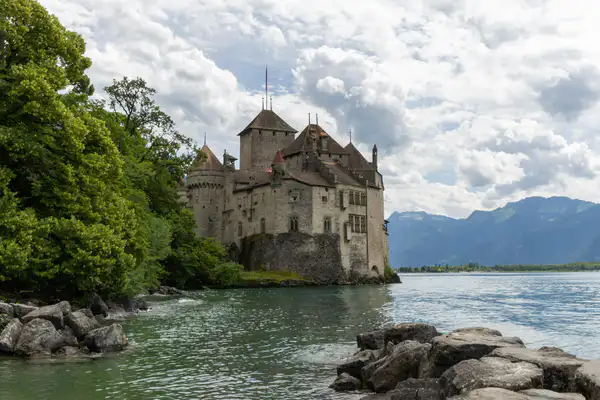
The Chateau de Chillon rises from a rocky island on the eastern shore of Lake Geneva like a stone ship anchored between water and mountain, its silhouette one of the most recognized and most painted in all of Switzerland. For over a thousand years this fortress has commanded the narrow passage between the lake and the steep Alpine slopes above, controlling the vital road that connected Italy to northern Europe through the Great St. Bernard Pass. No castle in Switzerland has been more visited, more written about, or more loved than Chillon, and its history reads like a compressed epic of European civilization: Roman road station, Savoyard stronghold, Bernese conquest, Romantic icon, and today one of the most carefully preserved medieval complexes on the continent. The castle as it stands today is largely the creation of the Counts of Savoy, who between the twelfth and fourteenth centuries transformed an existing fortification into an elaborate residential palace and military stronghold containing no fewer than twenty-five buildings arranged around three courtyards. The lakeside facade, with its towers reflected in the impossibly blue water, has inspired artists from Turner to Courbet, poets from Byron to Hugo, and has become the single most visited historical monument in Switzerland. But beneath the romantic beauty lies a harder history: the underground vaults served as a prison for centuries, and it was here that Francois de Bonivard, the prior of Geneva, was chained to a pillar for six years for the crime of supporting his city's independence. Lord Byron visited in 1816, carved his name on a pillar in the dungeon, and wrote The Prisoner of Chillon, the poem that transformed the castle from a regional landmark into an international symbol of the struggle for liberty. The castle's position is itself a masterpiece of strategic placement. The rocky island upon which it stands was a natural tollpoint: anyone traveling along the lakeshore road between the Rhone Valley and the north had no choice but to pass directly beneath its walls. The Savoys exploited this geography ruthlessly, extracting tolls, controlling trade, and projecting power across the entire eastern end of Lake Geneva for three centuries.
Historical Significance
“Chateau de Chillon is the most visited historical monument in Switzerland and one of the best-preserved medieval castles in Europe. Its strategic position on Lake Geneva controlled the vital trade route between Italy and northern Europe for centuries. The castle's fame was amplified enormously by Lord Byron's 1816 poem The Prisoner of Chillon, which made it a pilgrimage site for the Romantic movement and cemented its place in European literary history. The complex of 25 buildings around three courtyards preserves an extraordinarily complete picture of medieval castle life, from grand ceremonial halls with original wall paintings to the underground vaults that served as both storage and prison.”
物語
1History
👑 Built by
Counts of Savoy (major construction under Peter II of Savoy, 13th century)
~1005 AD - First documented mention of the castle on its rocky island in Lake Geneva
1150-1300 - Counts of Savoy transform Chillon into a major residential palace and military fortress
1253-1268 - Peter II of Savoy undertakes the most ambitious building campaign, creating much of the castle seen today
1530-1536 - Francois de Bonivard imprisoned in the underground vaults for supporting Genevan independence
1536 - Bernese forces capture Chillon and free Bonivard; castle passes from Savoyard to Bernese control
1798 - Vaudois revolution; castle becomes cantonal property
1816 - Lord Byron visits, carves his name on a dungeon pillar, writes The Prisoner of Chillon
1887 - Major restoration begins under archaeologist Albert Naef; continues through the 20th century
2016 - Castle receives over 400,000 visitors, confirming its status as Switzerland's most visited historical monument