
About
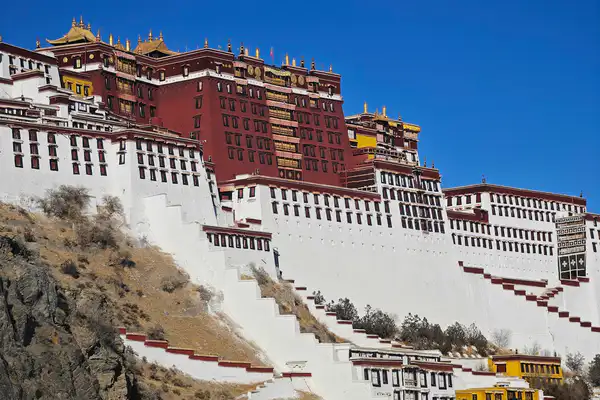
The Potala Palace is the highest palace in the world — a thirteen-story, 1,000-room fortress-monastery rising 117 meters above Lhasa's Marpo Ri (Red Hill) at an altitude of 3,700 meters. For three centuries, it served as the winter residence of the Dalai Lama and the administrative center of Tibetan government. It is the supreme symbol of Tibetan Buddhism and one of the most architecturally stunning buildings on Earth. The palace consists of two main sections: the White Palace (Potrang Karpo), containing the Dalai Lama's living quarters and government offices, and the Red Palace (Potrang Marpo), dedicated entirely to religious study and Buddhist prayer. The Red Palace contains the gold-encased funeral stupas of eight Dalai Lamas — towering structures covered in hundreds of kilograms of gold and studded with thousands of precious stones. The current structure was begun in 1645 by the Fifth Dalai Lama, Lobsang Gyatso, known as "The Great Fifth," and completed under the regency of Desi Sangye Gyatso in 1694. But the site's sacred history extends much further back: the original palace was built in 637 AD by Songtsen Gampo, the king who unified Tibet. The Potala contains over 200,000 statues, 10,000 painted scrolls (thangkas), murals covering 10,000 square meters, and an extensive library of Buddhist scriptures. It has survived wars, earthquakes, and political upheavals across 13 centuries, standing as an indomitable testament to Tibetan faith. UNESCO inscribed the Potala Palace in 1994. It remains one of the most revered pilgrimage destinations in the Buddhist world.
Historical Significance
“The Potala Palace is the physical manifestation of the Tibetan Buddhist belief in the union of spiritual and temporal power. The Dalai Lama — believed to be the incarnation of Avalokiteśvara, the Bodhisattva of Compassion — ruled both the spiritual and political life of Tibet from this palace. The palace's name comes from Mount Potalaka, the mythical abode of Avalokiteśvara in Indian Buddhist tradition. By naming his palace after the Bodhisattva's celestial home, Songtsen Gampo was making a profound claim: Lhasa was not merely a capital but a sacred space where heaven touched earth. The Fifth Dalai Lama's reconstruction transformed the Potala from a ruined fortress into the architectural marvel we see today. The construction required an enormous mobilization of resources: entire villages were conscripted for labor, gold was contributed from across the Tibetan world, and the finest artists were brought from Nepal and India. The palace's funeral stupas are among the most lavish monuments in the world. The stupa of the Fifth Dalai Lama stands 14.85 meters high and is covered with 3,721 kilograms of gold, inlaid with over 18,000 pearls and precious stones. The stupa of the Thirteenth Dalai Lama (completed in 1934) used 590 kilograms of gold. The palace survived the Chinese annexation of Tibet in 1950 and the Cultural Revolution (1966-1976) — reportedly on the personal order of Premier Zhou Enlai, who placed it under military protection while Red Guards destroyed thousands of other Tibetan monasteries.”
Истории
2History
👑 Built by
Songtsen Gampo (original, 637 AD); Fifth Dalai Lama Lobsang Gyatso (current structure, 1645-1694)
637 AD - King Songtsen Gampo builds the original palace on Red Hill for his bride, Princess Wencheng of Tang China
8th-9th century - Palace damaged in internal conflicts; partially abandoned
1645 - Fifth Dalai Lama begins reconstruction of the White Palace
1648 - White Palace completed; Fifth Dalai Lama moves Tibetan government from Drepung Monastery
1682 - Fifth Dalai Lama dies; his death is concealed for 15 years while the Red Palace is constructed
1694 - Red Palace completed by regent Desi Sangye Gyatso
1922 - Thirteenth Dalai Lama renovates the White Palace and adds modern elements
1950 - People's Liberation Army enters Lhasa
1959 - Fourteenth Dalai Lama flees the Potala Palace to India during the Tibetan uprising
1966-1976 - Cultural Revolution: palace survives on Zhou Enlai's order while thousands of monasteries are destroyed
1989 - Thirteenth Dalai Lama's funeral stupa restoration completed
1994 - Inscribed as UNESCO World Heritage Site
2006 - Major renovation project completed; palace structurally reinforced