
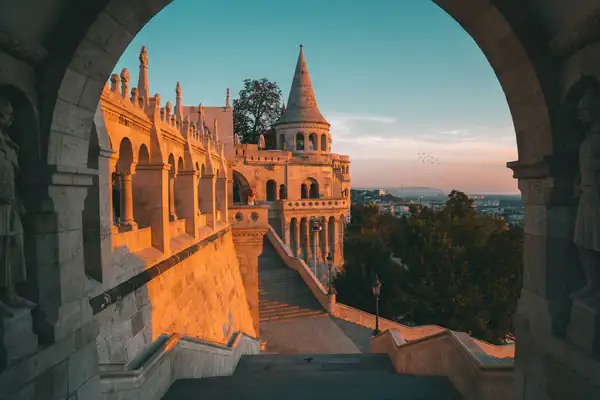
About
Buda Castle rises on Castle Hill like a sentinel over the Danube, bearing witness to 700 years of Hungarian triumph and tragedy. From Béla IV's first fortress after the Mongol devastation to the current Baroque-Neoclassical palace housing national museums, this castle has been destroyed and rebuilt more times than any comparable site in Europe. The castle reached its Renaissance pinnacle under King Matthias Corvinus (1458-1490), whose legendary library, the Bibliotheca Corviniana, contained over 2,000 illuminated manuscripts — the greatest collection in Europe outside the Vatican. Ottoman conquest in 1541 began 145 years of Islamic rule; the castle became a garrison town with the Gothic church converted to a mosque. The Great Siege of 1686 liberated Buda with such ferocity that the Ottomans and most of the medieval fabric perished together. Habsburg rebuilding created the Baroque palace that expanded over centuries. Emperor Franz Joseph and Empress Elisabeth (Sisi), who adored Hungary, added grand state rooms. The 1956 revolution saw freedom fighters hold the castle district against Soviet tanks. Communist neglect was followed by painstaking restoration. Today the castle complex includes the Hungarian National Gallery, Budapest History Museum, and the National Széchenyi Library. Beneath the palace, a labyrinth of caves and tunnels stretches for kilometers — including the chamber where Vlad III of Wallachia (the historical Dracula) was allegedly imprisoned for twelve years.
Historical Significance
“...s wedding to Beatrice of Aragon in 1476 brought Italian Renaissance culture north of the Alps. The Bibliotheca Corviniana — bound in purple leather with gold clasps — was consulted by scholars from across Europe. When the Ottomans sacked the castle in 1541, they scattered this irreplaceable library; only 216 of the original 2,000+ volumes survive in libraries worldwide. The Great Siege of 1686 is the most important date in Habsburg Hungary. The Holy League's 74,000 soldiers — Germans, Austrians, Hungarians, and Poles — broke Ottoman power in Central Europe. The victory cost 30,000 lives and left Buda a smoking ruin. The Habsburgs spent 200 years rebuilding. The 1956 revolution made the castle district a symbol of Hungarian resistance. Freedom fighters held these streets for days against Soviet tanks. The Communist regime then neglected the castle, allowing decay. Post-1989 restoration has returned the complex to its imperial splendor.”
Stories
3History
👑 Built by
King Béla IV (first fortress); King Matthias Corvinus (Renaissance palace); Habsburg architects (current form)
1241 - Mongols destroy Buda; King Béla IV resolves to build a castle that cannot fall
1265 - First stone castle completed on Castle Hill
1458 - Matthias Corvinus becomes king; begins transforming castle into Renaissance palace
1476 - Matthias marries Beatrice of Aragon; Italian artists flood Buda
1490 - Matthias dies; Bibliotheca Corviniana contains over 2,000 volumes
1526 - Battle of Mohács; Hungary divided; Ottomans approach
1541 - Sultan Suleiman captures Buda without siege; 145 years of Ottoman rule begin
1686 - Great Siege of Buda; Christian forces liberate city after 78-day siege
1715-1770 - Habsburg reconstruction creates current Baroque palace
1849 - Hungarians besiege Austrian garrison during revolution
1896 - Palace expanded for Millennium celebrations
1945 - Soviet siege destroys palace; German garrison holds for 50 days
1956 - Freedom fighters defend castle district against Soviet tanks
1987 - UNESCO World Heritage inscription