
About
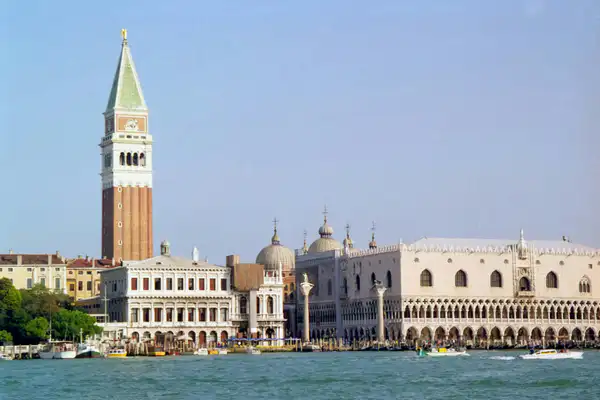
Venice — La Serenissima — the Most Serene Republic that endured for 1,100 years, longer than any other republic in human history. Built on 118 islands driven into the mud of a shallow lagoon, connected by more than 400 bridges and laced with 177 canals, Venice defied geography itself to become the wealthiest and most powerful maritime state in the Mediterranean. At its heart stands Piazza San Marco — "the drawing room of Europe," as Napoleon called it — flanked by the two buildings that embodied Venetian power, faith, and identity: St. Mark's Basilica and the Doge's Palace. St. Mark's Basilica is a Byzantine masterpiece unlike anything else in Western Europe. Its five great domes, modeled on the Church of the Holy Apostles in Constantinople, rise above a facade encrusted with over 500 marble columns plundered from across the Eastern Mediterranean. Inside, more than 85,000 square feet of gold glass mosaics cover every surface of the upper walls, domes, and vaults — an unbroken ocean of shimmering gold that earned the basilica the name "Chiesa d'Oro," the Church of Gold. The basilica was built for a single purpose: to house the stolen relics of St. Mark the Evangelist, smuggled out of Alexandria, Egypt, in 828 AD by two Venetian merchants who hid the saint's body under layers of pork to deter Muslim customs inspectors. The winged lion of St. Mark became Venice's eternal symbol, stamped on flags, coins, fortresses, and ships from the Adriatic to the Black Sea. The Doge's Palace, adjoining the basilica, was the seat of the Venetian Republic's government for nearly a millennium. Its extraordinary Gothic facade — a confection of pink Verona marble and white Istrian stone arranged in diamond patterns above an arcade of pointed arches — conceals one of the most sophisticated political machines ever devised. Within its walls, the Great Council of over 2,000 nobles debated and voted, the dreaded Council of Ten dispensed secret justice, and the Doge himself — elected for life but hedged about with more restrictions than any constitutional monarch — presided over a republic that balanced power with a complexity that fascinated Machiavelli. The palace connects via the enclosed Bridge of Sighs to the Prigioni Nuove, the New Prisons, where prisoners took their last look at Venice's beauty through small stone windows before descending to their cells — hence the bridge's romantic name, given by Lord Byron in the 19th century. Together, the basilica and palace represent Venice's unique position as the gateway between East and West. No other European city blended Byzantine, Gothic, Islamic, and Renaissance influences so seamlessly. The mosaics are Byzantine, the architecture is Gothic, the decorative motifs borrow from Islamic geometric patterns, and the great paintings within — by Tintoretto, Veronese, Bellini, and Titian — represent the pinnacle of the Venetian Renaissance. This was a republic built on trade, diplomacy, and a ruthless pragmatism that allowed it to do business with Christians and Muslims alike, and the art and architecture of San Marco and the Palazzo Ducale reflect that cosmopolitan genius in every stone and tessera.
Historical Significance
“St. Mark's Basilica and the Doge's Palace together constituted the spiritual and political nucleus of the Venetian Republic, one of the most enduring and influential states in European history. The basilica, originally built in 828 to house the relics of St. Mark the Evangelist stolen from Alexandria, was reconstructed in its present form between 1063 and 1094 under Doge Domenico Contarini, modeled on the Church of the Holy Apostles in Constantinople. Over the following centuries, every Venetian military and commercial triumph was commemorated by adding treasures to the basilica. The four bronze horses above the entrance were looted from Constantinople during the Fourth Crusade in 1204. Columns, capitals, and marble panels were taken from temples, churches, and palaces across the Byzantine Empire and the Islamic world. The result is a building that functions as a three-dimensional treasury of Mediterranean civilization — a physical record of Venice's reach and ambition. The Doge's Palace evolved from a fortified castle in the 9th century into the elaborate Gothic masterpiece visible today, largely rebuilt between the 14th and 15th centuries. It housed not merely the Doge but the entire apparatus of Venetian government: the Great Council (Maggior Consiglio), the Senate, the Council of Ten, the State Inquisitors, the law courts, the armory, and the prisons. The palace's Great Council Chamber, decorated with Tintoretto's "Paradise" — the largest oil painting on canvas in the world at 22 meters wide — could accommodate all 2,000 members of the Venetian nobility who had the right to vote. The complex was inscribed as part of the UNESCO World Heritage Site "Venice and its Lagoon" in 1987, recognizing it as an irreplaceable masterpiece of human creative genius and a unique example of a city built on water that has maintained its extraordinary artistic patrimony for over a millennium.”
القصص
3History
👑 Built by
Doge Giustiniano Partecipazio (first basilica, 828 AD); Doge Domenico Contarini (current basilica, 1063-1094); successive Doges (palace, 9th-15th centuries)
828 AD - Relics of St. Mark stolen from Alexandria and brought to Venice
832 AD - First basilica completed under Doge Giustiniano Partecipazio
976 AD - Basilica damaged by fire during a popular revolt against Doge Pietro IV Candiano
1063 - Reconstruction of the basilica begins under Doge Domenico Contarini
1094 - Current basilica consecrated; relics of St. Mark rediscovered in a pillar
1204 - Four bronze horses looted from Constantinople during the Fourth Crusade installed on facade
1309-1424 - Major reconstruction and expansion of the Doge's Palace in Gothic style
1577 - Great fire damages the Doge's Palace; Tintoretto and Veronese commissioned for restoration
1797 - Napoleon conquers Venice, ending the Republic; loots the bronze horses to Paris
1815 - Bronze horses returned to Venice after Napoleon's defeat at Waterloo
1987 - Venice and its Lagoon inscribed as UNESCO World Heritage Site