
About
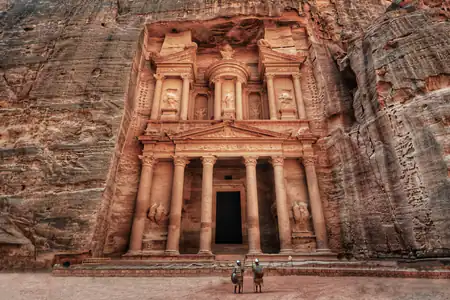
Hidden within the rose-red sandstone mountains of southern Jordan, Petra is one of the most extraordinary archaeological sites on Earth — a vast Nabataean metropolis carved directly into towering cliff faces, where monumental facades emerge from living rock as if sculpted by gods rather than human hands. The ancient city sprawls across a landscape of narrow gorges, sweeping valleys, and soaring plateaus covering some 264 square kilometers, but its heart is reached through the Siq, a kilometer-long chasm barely wide enough for two camels to pass abreast, where walls of striated sandstone rise 80 meters overhead in bands of crimson, ochre, violet, and gold. At the end of this natural corridor, the first glimpse of Al-Khazneh — the Treasury — takes the breath away: a Hellenistic facade 40 meters tall and 25 meters wide, carved with divine precision into a cliff of salmon-pink rock, its Corinthian columns, friezes, and tholos seemingly impossible in their delicacy. Petra was the capital of the Nabataean Kingdom, an Arab people who transformed themselves from nomadic pastoralists into the wealthiest traders of the ancient world between the 4th century BC and the 1st century AD. Commanding the crossroads of the incense routes that carried frankincense from Arabia Felix, spices from India, silk from China, and pearls from the Red Sea, the Nabataeans grew fabulously rich by taxing, protecting, and warehousing these caravans. At its zenith under King Aretas IV (9 BC - 40 AD), Petra may have housed 30,000 inhabitants in a city that boasted a colonnaded main street, a massive theatre seating 8,500 carved entirely from rock, temples, royal tombs, markets, a nymphaeum, and an astonishingly sophisticated hydraulic system that turned a desert canyon into a garden city. The Nabataeans engineered a network of dams, cisterns, ceramic pipes, and carved water channels that captured seasonal flash floods and redirected springs from as far as 25 kilometers away, delivering an estimated 40 million liters of fresh water daily — a feat of hydro-engineering that rivaled Rome itself. The city's architecture reveals a culture uniquely positioned at the crossroads of civilizations. The Treasury's facade blends Hellenistic, Egyptian, and native Nabataean elements — its carved eagles, Amazons, and Medusa heads speak to Greek influence, while the goddess figures flanking the upper tholos likely represent Al-Uzza, the great Nabataean deity associated with Aphrodite and Isis. The Royal Tombs along the eastern cliff face — the Urn Tomb, the Silk Tomb, the Corinthian Tomb, and the Palace Tomb — display an evolution from austere Assyrian-influenced block facades to elaborate multi-story compositions rivaling anything in Rome. The great temple of Qasr al-Bint, the only major freestanding structure, was dedicated to Dushara, the supreme Nabataean god, and its 23-meter-high walls still stand as testimony to Nabataean masonry. High above the valley floor, the Monastery (Ad-Deir) — reached by climbing 800 rock-cut steps — presents a facade even larger than the Treasury at 50 meters wide and 45 meters tall, its massive doorway standing 8 meters high. After the Roman annexation of the Nabataean Kingdom in 106 AD, Petra continued as a prosperous provincial city before gradually declining as trade routes shifted north to Palmyra and sea routes replaced overland caravans. A devastating earthquake in 363 AD destroyed much of the city's infrastructure, and by the 7th century, Petra was largely abandoned to the Bedouin tribes who kept its location a jealously guarded secret for centuries. The city was unknown to the Western world until August 22, 1812, when Swiss explorer Johann Ludwig Burckhardt, disguised as an Arab pilgrim named Sheikh Ibrahim Ibn Abdallah, persuaded his Bedouin guide to lead him through the Siq on the pretext of sacrificing a goat at the Tomb of Aaron (Jabal Haroun), the mountain peak above Petra where the brother of Moses is believed to be buried. Burckhardt's diary entry upon seeing the Treasury — 'a situation of great interest' — was the understatement of archaeological history. Inscribed as a UNESCO World Heritage Site in 1985 under criteria (i), (iii), and (iv), and voted one of the New Seven Wonders of the World in 2007, Petra today stands as perhaps the single most dramatic marriage of human artistry and natural landscape anywhere on Earth.
Historical Significance
“Petra represents one of the most remarkable achievements in the history of human civilization — a city where architecture, engineering, commerce, and religion fused into something unlike anything else in the ancient world. The Nabataeans were among history's most successful cultural intermediaries: originally Arabic-speaking nomads from the Arabian Peninsula, they absorbed and synthesized influences from Egypt, Mesopotamia, Greece, and Rome while maintaining a fiercely independent identity. Their kingdom controlled the most lucrative trade routes in antiquity, and the wealth this generated funded the creation of a city that astonished even the Romans. The engineering genius of Petra is often underappreciated. In a region receiving barely 150 millimeters of annual rainfall, the Nabataeans created a hydraulic infrastructure of breathtaking sophistication. They carved channels into cliff faces, built dams across the Siq to redirect flash floods into underground cisterns, and laid ceramic pipelines that delivered water under pressure to fountains, pools, and a paradeisos (paradise garden) in the heart of the city. Recent archaeological work has revealed that Petra's water system included settling tanks for purification and distribution networks that served individual residences. The great dam at the entrance to the Siq, built to divert the Wadi al-Mudhlim away from the narrow gorge, protected the city from catastrophic flooding and still stands today. Petra's religious significance extends across multiple traditions. For Muslims and Christians, the mountain of Jabal Haroun (Mount Aaron), rising 1,353 meters above the city, is venerated as the burial place of the Prophet Harun (Aaron), brother of Musa (Moses). A 14th-century Mamluk shrine crowns the summit and remains a pilgrimage site. The Nabataeans themselves practiced a sophisticated polytheistic religion centered on the god Dushara ('Lord of the Shara Mountains') and the goddess Al-Uzza, worshipped through sacred stone pillars (baetyls) and elaborate processional rituals whose traces are carved throughout the city. Petra's rediscovery in 1812 by Burckhardt ignited a wave of European exploration and romantic fascination that continues to this day. Dean Burgon's 1845 poem immortalized it as 'a rose-red city half as old as time.' UNESCO inscribed Petra in 1985, recognizing it as a masterpiece of human creative genius, an outstanding example of a type of building ensemble illustrating a significant stage in human history, and an exceptional testimony to the Nabataean civilization. The site was voted one of the New Seven Wonders of the World in 2007 in a global poll of over 100 million votes. Archaeological work continues to reveal that only an estimated 15% of Petra has been excavated — the vast majority of this astonishing city remains hidden beneath the sands and within the mountains.”
Geschichten
3History
👑 Built by
Nabataean Kingdom (primarily under Kings Obodas I, Aretas III, and Aretas IV, 1st century BC - 1st century AD)
~6th century BC - Edomites inhabit the Petra region; possible references in the Hebrew Bible to 'Sela' (rock)
~4th century BC - Nabataean Arabs settle in Petra, displacing the Edomites
312 BC - Earliest historical reference: Antigonus I Monophthalmus sends two failed expeditions against the Nabataeans at Petra (recorded by Diodorus Siculus)
~168 BC - Earliest known Nabataean king, Aretas I, mentioned in connection with the Maccabean revolt
~100-62 BC - Reign of Aretas III 'Philhellene'; Petra becomes a major Hellenistic city; coinage begins
64 BC - Pompey's Roman legions approach Petra but negotiate peace rather than besiege the impregnable city
9 BC - 40 AD - Reign of Aretas IV, 'He who loves his people'; Petra reaches its zenith with ~30,000 inhabitants
~1st century AD - Construction of the Treasury (Al-Khazneh), likely as a royal mausoleum for Aretas IV or Aretas III
106 AD - Roman Emperor Trajan annexes the Nabataean Kingdom; Petra becomes capital of the province of Arabia Petraea
~2nd century AD - Roman-period colonnaded street, triumphal arch, and baths constructed
363 AD - Devastating earthquake destroys roughly half of Petra's buildings and cripples its water system
~5th-6th century AD - Byzantine churches built; Petra Papyri (carbonized scrolls) deposited in church archive
~7th century AD - Petra largely abandoned after the Islamic conquest shifts trade routes
12th century - Crusaders build a small fort (al-Wu'ayra) near Petra; Baldwin I briefly occupies the area
August 22, 1812 - Johann Ludwig Burckhardt becomes the first modern European to enter Petra
1929 - First systematic archaeological excavations begin under George Horsfield and Agnes Conway
1985 - UNESCO World Heritage Site inscription (criteria i, iii, iv)
1993 - Petra Papyri discovered: 152 carbonized Byzantine-era scrolls revealing 6th-century daily life
2007 - Voted one of the New Seven Wonders of the World
2016 - Satellite imagery reveals massive previously unknown monumental platform 56 x 49 meters south of the city center