
About
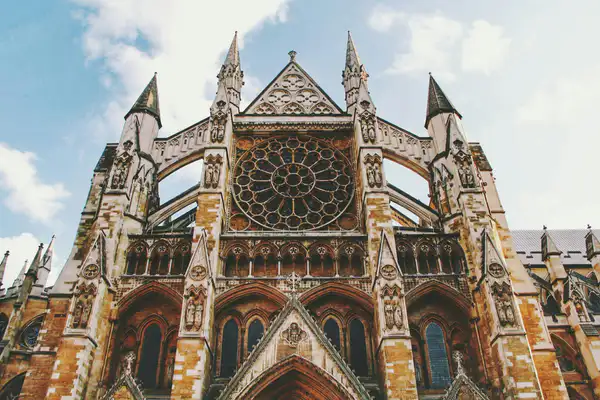
Westminster Abbey — formally the Collegiate Church of Saint Peter at Westminster — is one of the most significant religious buildings in the Western world and the spiritual heart of the British nation. Founded as a Benedictine monastery around 960 AD during the reign of King Edgar the Peaceful, the abbey was transformed into a great Norman church by Edward the Confessor between 1042 and 1065, then rebuilt in its present soaring Gothic form by Henry III beginning in 1245. For nearly a thousand years, it has served as the coronation church of English and British monarchs, the burial place of kings, queens, poets, scientists, statesmen, and warriors, and a living symbol of the continuity of the English Crown and the English-speaking peoples. No other building on earth has witnessed so many of the defining moments of a nation's history within its walls. The abbey's architecture represents the finest flowering of English Gothic, with the tallest nave in England soaring to 31 meters — a deliberate echo of the great French cathedrals at Reims and Amiens that Henry III so admired. Yet Westminster Abbey is no mere architectural achievement. It is a national reliquary, housing the mortal remains and memorials of more than 3,300 individuals who shaped the course of British and world history. The Confessor's Shrine behind the high altar draws pilgrims still. The tombs of medieval kings — Henry III, Edward I, Edward III, Henry V, Henry VII — lie in their original splendor. Elizabeth I and her half-sister Mary I share a tomb in the north aisle of the Henry VII Lady Chapel, Protestant and Catholic queens reconciled in death. Charles Darwin lies beside Isaac Newton in the nave. Geoffrey Chaucer's burial in the south transept founded Poets' Corner, which now commemorates Shakespeare, Dickens, Kipling, Hardy, Tennyson, Handel, and scores of others whose words and music defined the English language and imagination. Beyond its function as a royal mausoleum and coronation church, Westminster Abbey has been the stage for the great ceremonies of state that mark the rhythm of national life. Every coronation since William the Conqueror in 1066 has taken place here — from the boy king Henry III, crowned at nine years old with his mother's bracelet because the Crown Jewels were in French hands, to Charles III in 2023. Sixteen royal weddings have been celebrated within its walls, including those of Elizabeth II and Prince Philip in 1947, and William and Catherine in 2011. State funerals, memorial services, and acts of national mourning and thanksgiving all converge on this single building. The Tomb of the Unknown Warrior, buried in the nave floor on Armistice Day 1920, has become the most sacred secular memorial in the English-speaking world — the one grave in the abbey upon which no person, not even the sovereign, is permitted to walk. Westminster Abbey is not merely a church or a monument; it is the place where a nation remembers who it is, where it came from, and what it owes to those who came before.
Historical Significance
“Westminster Abbey holds a position in English and British history that is without parallel. It is the only building in the world that has served continuously as the coronation church of a reigning monarchy for nearly a thousand years. Every English and British sovereign since William the Conqueror has been crowned here — with the sole exceptions of Edward V, who was murdered in the Tower before his coronation, and Edward VIII, who abdicated before his. The Coronation Chair, commissioned by Edward I in 1296 to enclose the captured Stone of Scone, has been used at every coronation since 1308, making it the oldest piece of furniture in England still serving its original purpose. As a royal burial church, Westminster Abbey contains the most extraordinary concentration of historically significant graves on earth. Seventeen monarchs are interred here, from Henry III to George II, alongside their consorts, children, and the great figures of every age. The Henry VII Lady Chapel, with its breathtaking fan-vaulted ceiling — described by John Leland as the "wonder of the world" — contains the magnificent Renaissance tomb of Henry VII and Elizabeth of York, the work of the Florentine sculptor Pietro Torrigiano. Elizabeth I lies in the north aisle, her effigy one of the most recognized images of the Tudor era. Mary Queen of Scots, beheaded on Elizabeth's orders, was later moved to the south aisle by her son James I, who placed her in a tomb deliberately grander than Elizabeth's — a posthumous act of filial devotion and political symbolism. Beyond royalty, the abbey's memorials chart the intellectual, literary, and scientific achievements of the English-speaking world. Poets' Corner, begun with Chaucer's burial in 1400, has become the most prestigious literary address on earth. Isaac Newton's monument dominates the nave, and his grave lies nearby alongside those of Charles Darwin, Stephen Hawking, Ernest Rutherford, and J.J. Thomson — a constellation of scientific genius unmatched by any other single building. The Tomb of the Unknown Warrior, created in 1920, transformed the abbey into a place of national mourning and remembrance, its inscription — "They buried him among the kings because he had done good toward God and toward his house" — one of the most moving epitaphs ever composed. Westminster Abbey is, in the deepest sense, the memory palace of the English-speaking world, where the living come to commune with the dead and to renew the bonds that tie a nation to its past.”
Geschichten
2History
👑 Built by
Edward the Confessor (rebuilt 1042-1065) / Henry III (Gothic rebuilding 1245-1272)
960 AD - Benedictine monks establish a monastery on Thorney Island, a marshy site at the confluence of the Tyburn and the Thames
1042-1065 - Edward the Confessor rebuilds the monastery into a great Romanesque church, the largest in England at the time
1065 - Westminster Abbey is consecrated on December 28; Edward the Confessor is too ill to attend and dies eight days later
1066 - Harold Godwinson is crowned in the Abbey; William the Conqueror is crowned on Christmas Day, beginning the unbroken coronation tradition
1245 - Henry III begins demolishing Edward's church and rebuilding in the French Gothic style, a project that will take over 250 years to complete
1269 - The body of Edward the Confessor is translated to a magnificent new shrine behind the high altar, becoming England's premier pilgrimage destination
1296 - Edward I brings the Stone of Scone from Scotland and commissions the Coronation Chair to house it
1400 - Geoffrey Chaucer is buried in the south transept, founding what will become Poets' Corner
1503 - Henry VII begins construction of the Lady Chapel, the masterpiece of English Perpendicular Gothic, completed in 1519
1540 - Henry VIII dissolves the Benedictine monastery during the English Reformation; the abbey becomes a cathedral briefly before becoming a Royal Peculiar
1685 - Henry Purcell, organist of Westminster Abbey, is buried at the foot of the organ he played
1727 - George Frideric Handel's "Zadok the Priest" is performed at the coronation of George II and has been sung at every coronation since
1920 - The Unknown Warrior is buried in the nave on Armistice Day, November 11, in the presence of King George V
1937 - The coronation of George VI is the first to be broadcast on BBC radio
1947 - Princess Elizabeth (future Elizabeth II) marries Prince Philip, Duke of Edinburgh
1953 - The coronation of Elizabeth II is the first to be televised, watched by 27 million viewers in the United Kingdom
2011 - The wedding of Prince William and Catherine Middleton draws a global television audience of over two billion
2018 - The ashes of Stephen Hawking are interred near the grave of Isaac Newton
2022 - The lying-in-state and funeral of Queen Elizabeth II, the largest ceremonial event in British history
2023 - The coronation of King Charles III, with the Stone of Destiny returned from Scotland for the ceremony